

Q-weak: A Precision Test of the Standard Model and Determination of the Weak Charges of the Quarks through Parity-Violating Electron Scattering

An international collaboration of scientists working at Jefferson Lab has completed a new precision measurement of parity-violating electron scattering on the proton at very low Q2 and forward angles to challenge predictions of the Standard Model and search for new physics. A unique opportunity existed to carry out the first precision measurement of the proton's weak charge, QpW=1 - 4sin2θW, at JLab, building on technical advances that have been made in the laboratory's world-leading parity violation program and using the results of earlier parity violating electron scattering (PVES) experiments to constrain hadronic corrections. Under analysis are the data collected during a multi-year measurement of the parity violating asymmetry in elastic ep scattering at Q2=0.025 (GeV/c)2 employing 180 µA of 89% polarized beam on a 35 cm liquid Hydrogen target to precisely determine the proton's weak charge.
The Standard Model of electro-weak interactions makes a firm prediction of QpW, based on the running of the weak mixing angle sin2θW from the Z0 pole down to low energies, corresponding to a 10σ effect in our experiment. Any significant deviation of sin2θW from the Standard Model prediction at low Q2 would be a signal of new physics, whereas agreement would place new and significant constraints on possible Standard Model extensions. In the absence of physics beyond the Standard Model, our experiment will provide a ≅0.3% measurement of sin2θW, making this a very competitive standalone measurement of the weak-mixing angle.
The Electroweak Standard Model (SM) has to date been enormously successful although it is known to be incomplete. The search for a fundamental description of nature beyond the SM is driven by two complementary experimental strategies. The first is to build increasingly energetic colliders, such as the Large Hadron Collider (LHC) at CERN, to excite matter into a new form. The second approach is to perform high precision measurements where an observed discrepancy with the SM would reveal the signature of new forms of matter.
Results from our Commissioning Run (about 4% of our full data set):
From these initial results the measured asymmetry is Aep = -279 ± 35 (statistics) ± 31 (systematics) ppb, which is the smallest and most precise asymmetry ever measured in polarized ep scattering. The small Q2 of this experiment has made possible the first determination of the weak charge of the proton, QpW, by incorporating earlier parity-violating electron scattering (PVES) data at higher Q2 to constrain hadronic corrections. The value of QpW obtained in this way is QpW(PVES) = 0.064 ± 0.012, in good agreement with the Standard Model prediction of QPW(SM) = 0.0710 ± 0.0007. When this result is further combined with the 133Cs atomic parity violation (APV) measurement, significant constraints on the weak charges of the up and down quarks can also be extracted. That PVES + APV analysis reveals the neutron’s weak charge to be QnW(PVES+APV) = -0.975 ± 0.010.
 |
 |
 |
 |
 |
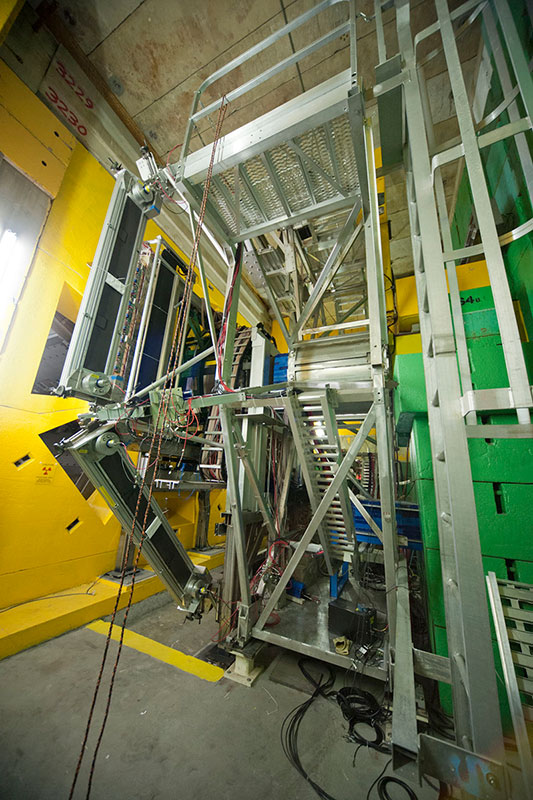 |
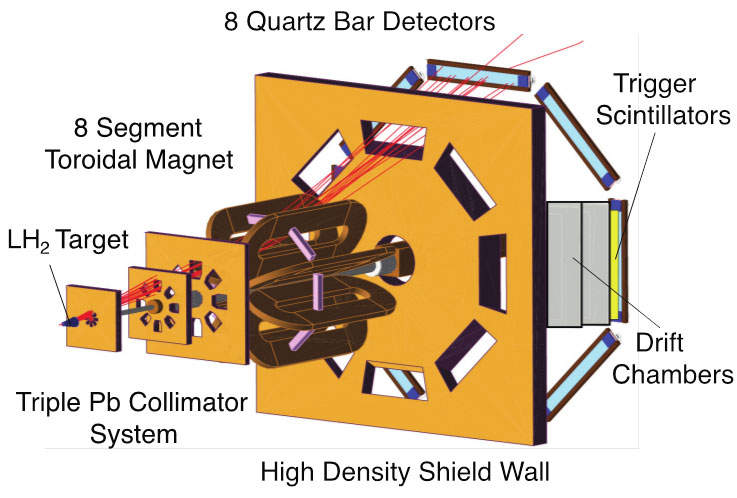
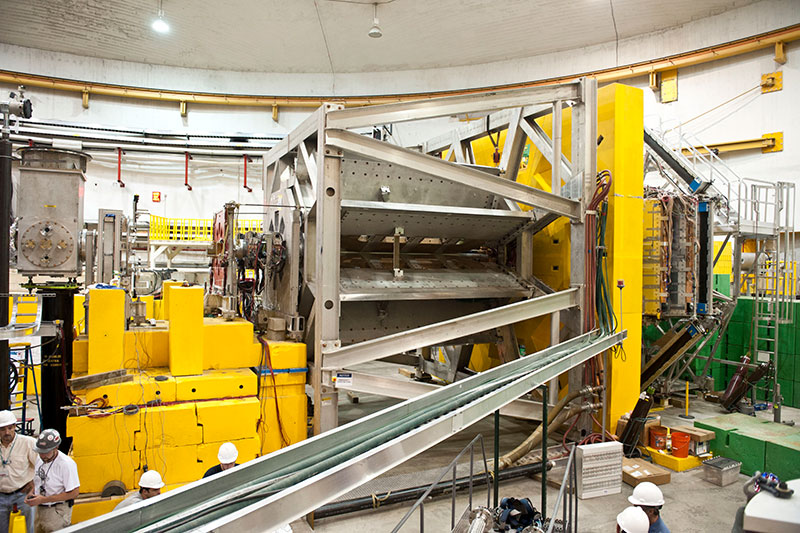
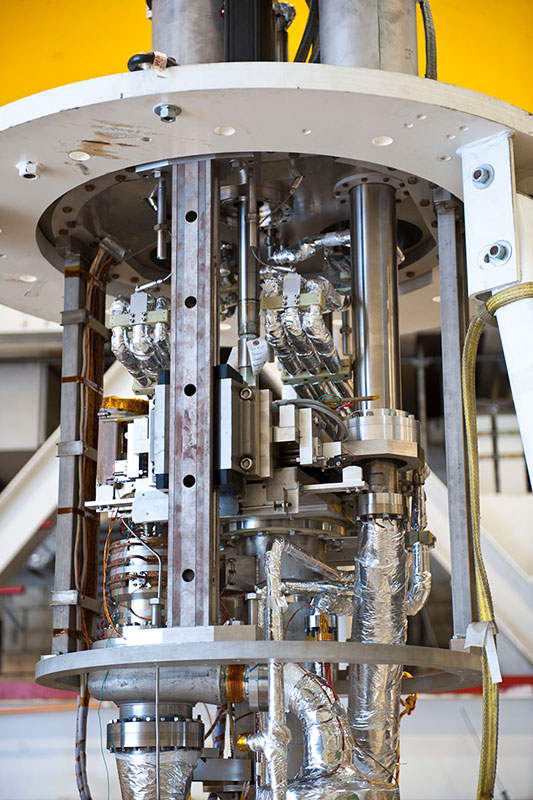
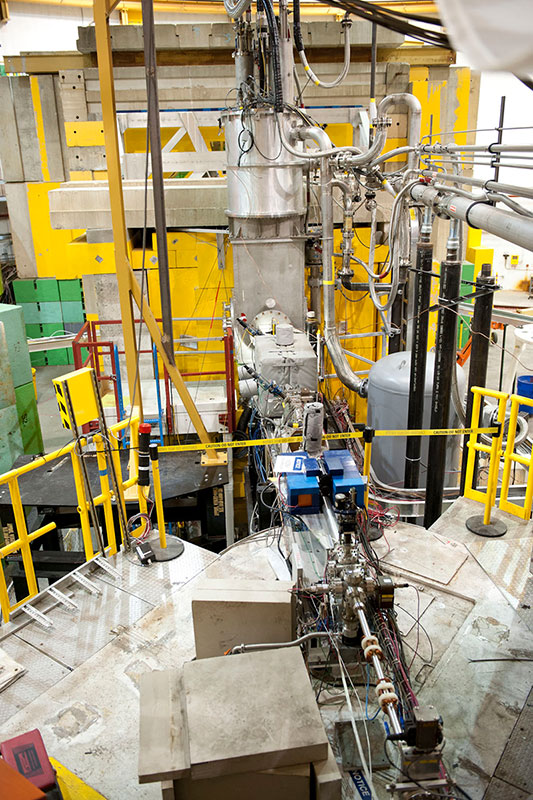
FIG. 1 and 2. Schematic of the basic experiment design (with photos of the apparatus under assembly on the right) shows the target, collimation, magnet coils, electron trajectories, and detectors. Elastically scattered electrons (red tracks) focus at the detectors while inelastically scattered electrons (not shown), are swept away from the detectors (to larger radii). The distance along the beamline from the target center to the center of the quartz bar detector array is 12.2 m.
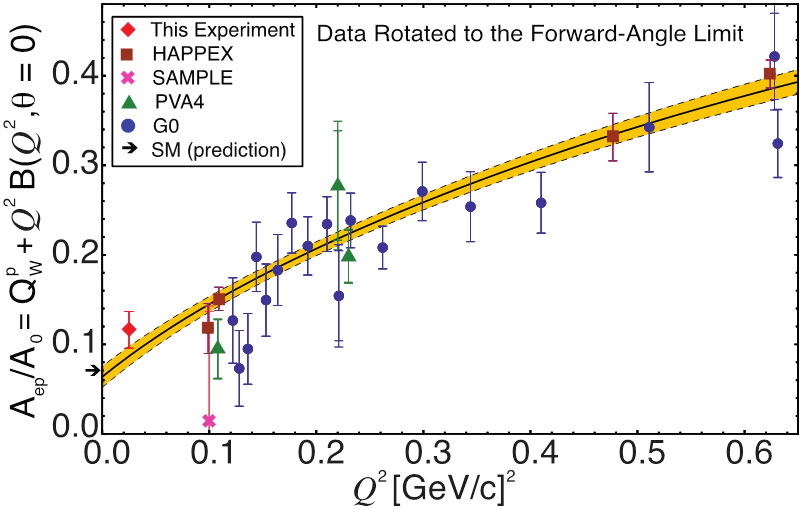
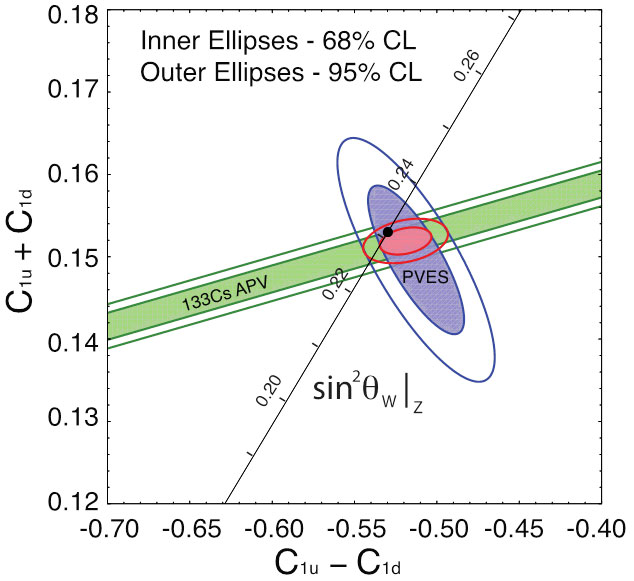
FIG. 3. Global fit result (solid line) from only 4% of our data full set (presented in the forward angle limit as reduced asymmetries derived from this measurement as well as other PVES experiments up to Q2=0.63(GeV/c)2, including proton, helium and deuterium data. The yellow shaded region indicates the uncertainty in the fit. QpW is the intercept of the fit. The SM prediction is also shown (arrow).
FIG. 4. The constraints on the neutral-weak quark coupling constants C1u - C1d (isovector) and C1u + C1d (isoscalar) from only 4% of our data full set. The more horizontal (green) APV band (shown at Χ2 = 2.3) provides a tight constraint on the isoscalar combination from 133Cs data. The more vertical (blue) ellipse represents the global fit of the existing Q2 < 0.63 PVES data including our newest result reported here at Q2=0.025 (GeV/c)2. The smaller (red) ellipse near the center of the figure shows the result obtained by combining the APV and PVES information. The SM prediction as a function of sin2θw in the MS scheme is plotted (diagonal black line) with the SM best fit value indicated by the (black) point at sin2θw=0.23116 at the Z pole.