

Theory Center Research Highlights
Lattice QCD

Form factors for electromagnetic transitions from second excited tensor state in charmonium (χc2'') to vector ground state (J/ψ). Shown are electric dipole, magnetic quadrupole and electric octopole amplitudes.
"Exotic and excited-state radiative transitions in charmonium
from lattice QCD"
J.J. Dudek, R.G. Edwards, C. Thomas
Phys. Rev. D 79, 094504 (2009)
Extending the techniques used to obtain the excited state mass spectrum of charmonium and the ground state radiative transitions, the amplitudes for the transitions A* → B γ are extracted. The expected patterns for conventional (heavy quark-antiquark) mesons are observed along with the first QCD estimates of photocouplings of conventional mesons to hybrid mesons (in which the gluonic field plays an explicit role). These couplings are found to be large, supporting the photoproduction mechanism proposed by the GlueX experiment. Ongoing research work using the techniques developed in this study will test this in the relevant light-quark sector.
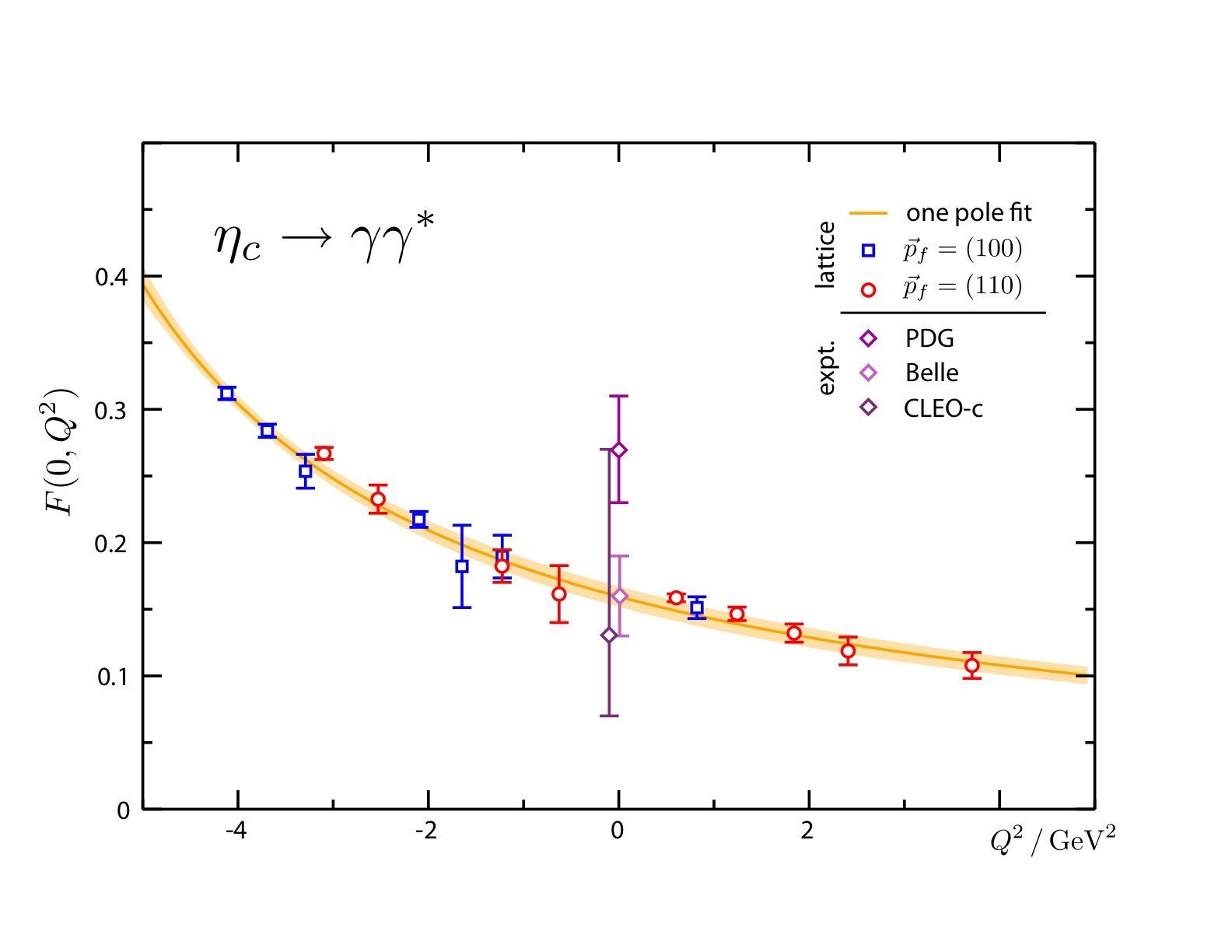
Form factor for two-photon decay of ηc mesons extracted from lattice QCD calculation. Experimental data at both photons real point from Particle Data Group, Belle and CLEO-c. Similar results are obtained also for the χc0 mesons.
"Two photon decays of charmonia from lattice QCD"
J.J. Dudek, R.G. Edwards
Phys. Rev. Lett. 97, 172001 (2006)
Extracting the amplitude for a two-photon decay of a meson from Euclidean Lattice QCD is not straightforward as it corresponds to a correlator having no QCD eigenstate in the final state. A method using the Lehmann-Symanzik-Zimmermann reduction to relate a photon to a linear superposition of QCD vector eigenstates is tested and found successful in describing the decays of pseudoscalar and scalar charmonium mesons, ηc, χc0.
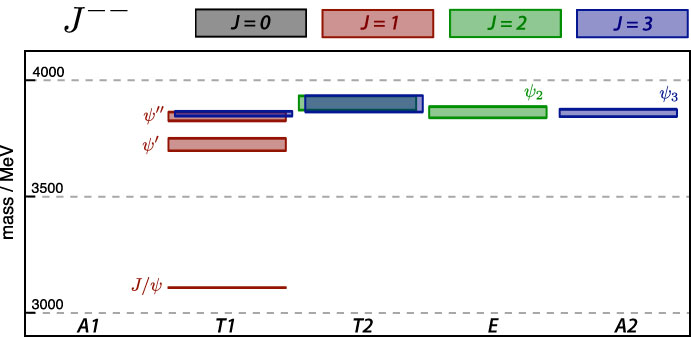
Negative parity and charge conjugation spectrum extracted from lattice QCD.
"Charmonium excited state spectrum in lattice QCD"
J.J. Dudek, R.G. Edwards, N. Mathur, D.G. Richards
Phys. Rev. D 77, 034501 (2008)
The excited state mass spectrum of meson states built from the heavy charm quarks is extracted from a lattice QCD calculation. Utilizing a large basis of quark-gluon composite operators, the spectrum is reliably obtained by variational analysis of a matrix of correlation functions. The power of this technique is demonstrated by the first extraction of the near-degenerate pair of states ψ' and ψ''.

The figure shows the lattice measurement of the pion form factor (open symbols), with the bands showing the corresponding vector-meson-dominance fits. The solid symbols show the current experimental determination.
"Lattice computation of the pion form factor"
F.D.R. Bonnet, R.G. Edwards, G.T. Fleming, R. Lewis, D.G. Richards
Phys. Rev. D 72, 054506 (2005)
The study of the pion form factor Fπ(Q2) provides a good laboratory for investigating the onset of perturbative QCD in exclusive processes, exploring the transtion from strong QCD (confinement) to the pQCD regime. Its determination is an important component of the Hall C experimental program both at 6 GeV and at 12 GeV. Recently, members of the JLab Theory Center collaborated on a lattice study of the pion form factor, employing the Jefferson Laboratory lattice cluster facility. The calculation was performed in full QCD, with pion masses down to around 300 MeV. They attained values of Q2 comparable with the ongoing experiment JLab E01-004, and showed that a vector-meson-dominance form provided a faithful description of the data over the explored energy range. Future work will extend this calculation both to lighter quark masses, and to still larger energies commensurate with the 12 GeV experimental program, enabling a detailed study of this benchmark quantity in hadronic physics.
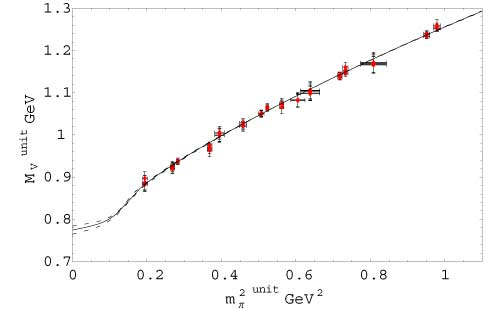
Lattice simulation results after correcting for finite-volume, finite lattice spacing and partial-quenching artifacts. The curve dispalys the continuum extrapolation to the physical pion mass.
"Chiral and continuum extrapolation of partially-quenched lattice results"
C.R. Allton, W. Armour, D.B. Leinweber, A.W. Thomas, R.D. Young
Phys. Lett. B 628, 125 (2005)
The vector meson mass is extracted from a large sample of partially quenched, two-flavor lattice QCD simulations. For the first time, discretisation, finite-volume and partial quenching artefacts are treated in a unified framework which is consistent with the low-energy behaviour of QCD. This analysis incorporates the leading infrared behaviour dictated by chiral effective field theory. As the two-pion decay channel cannot be described by a low-energy expansion alone, a highly-constrained model for the decay channel of the rho-meson is introduced. The latter is essential for extrapolating lattice results from the quark-mass regime where the rho is observed to be a physical bound state.