|
|
TITLE: |
||
|
|
|||
|
DOCUMENT ID: |
6122
Appendix T4 Respiratory
Health Effects Due to Inhalation
of Fumes from Welding and Brazing |
||
|
|
|||
1.0
Exposure Assessment Requirements
for Chemical Exposure through Inhalation Route
Examples of
potential exposure to chemicals while welding include exposure to welding fumes,
welding
gases, decomposition gases, and decomposition products of the welding consumables:
· Fumes are fine, solid particles. Fumes can be formed as a result of welding operations.
·
Gases may be produced in
certain welding
processes in the following ways:
o Decomposition of flux or electrode coatings and base metal
coatings such as paints and solvents.
o Reaction products of the shielding gases.
o Oxidation of elements present in the arc or flame.
o Photochemical reaction of atmospheric gases due to ultraviolet
radiation from the arc or flame.
·
The electrode coating is a
complex mixture of various components such as:
o Molding Agents (aluminum and magnesium silicate)
o Extruding Agents (alginates, starch, glucose and methyl cellulose)
o Binders (potassium and sodium silicates)
o Strengthening Agents (mostly mica which has replaced asbestos)
o Slag Formers (carbonates, silicates, oxides-rutile (TiO2) and fluorides)
o Metal Powders (e.g., iron) to act as alloying additions, to
increase deposition rate or act as deoxidants
o Shielding Gas Formers (cellulose, calcium carbonate)
o Fluxing Agents (fluorspar, calcium carbonate and sodium silicate)
The welder must
avoid the breathing the welding fume:
In order to control exposure, local or
general exhaust ventilation must be provided during welding to
maintain concentrations of toxic materials within acceptable limits. The table lists examples of potential
respiratory hazards associated with welding:
|
Substance |
Source |
Potential Health Effects |
|
FUMES |
||
|
Cadmium |
welding or cutting of metal coated with cadmium some brazing pastes contain cadmium |
acute irritation of the respiratory passages, delayed pulmonary edema; lung and kidney damage |
|
Chromium |
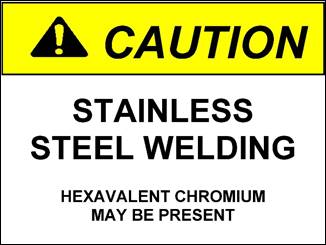
use of chrome-plated, or stainless steels or of hard-facing and chrome alloy electrodes |
some forms of chromium have been found to be carcinogenic; other forms are biologically inert |
|
Cobalt |
welding or cutting of certain alloys |
shortness of breath, inflammation of the lungs |
|
Fluorides |
certain fluxes contain fluoride and can give rise to dust, fume and vapor |
irritation of eyes, throat, respiratory tract and skin; long-term exposure can lead to bone hardening |
|
Iron |
welding or cutting of ferrous materials |
siderosis (temporary): inflammation of the lung due to iron deposition |
|
Lead |
welding or cutting of metal coated with lead or lead-based paints |
central nervous system & gastro-intestinal effects |
|
Manganese |
use of manganese-containing electrode cores, coatings or wire; welding of manganese steel |
metal fume fever, nervous system |
|
Molybdenum |
welding or cutting of molybdenum-containing alloys |
bronchial irritation, liver and kidney changes |
|
Nickel |
welding and cutting of nickel-plated and stainless steels |
irritation of respiratory tract; potentially carcinogenic |
|
Silica (and silicates) |
certain fluxes or dirt contamination could cause silica fume emissions |
amorphous and not regarded as harmful |
|
Vanadium |
use of certain filler wires and special alloy steels |
eye and respiratory tract irritation; chemical pneumonia |
|
Zinc |
welding or cutting of galvanized steel |
metal fume fever |
|
Other Metals |
welding may produce fumes of other metals such as aluminum, copper, magnesium, tin, titanium and tungsten |
no known serious health disorders are known to be due exposure to these fumes |
|
GASES |
||
|
Oxides of Nitrogen |
formed by the direct combination of oxygen and nitrogen in the air surrounding the arc or flame |
not a problem in outdoor or open shop welding; in confined spaces can build up to levels that can cause respiratory irritation or delayed pulmonary edema |
|
Ozone |
formed by certain welding operations, particularly when high amperages are involved, by the action of ultraviolet radiation on oxygen in the air |
very irritant to the upper respiratory tract and lungs (effect may be delayed) |
|
Carbon Monoxide |
reduction of carbon dioxide shielding gas and to some extent in all welding operations due to reduction of consumables or incomplete combustion of acetylene |
can cause drowsiness, headaches and nausea; unconsciousness and death can result in extreme cases |
|
Carbon Dioxide |
shielding gas or combustion product |
can be an asphyxiant |
|
Phosgene |
formed by the oxidation of chlorinated hydrocarbons (trichloroethylene, etc.) in the atmosphere or on the weld piece |
irritation to the respiratory tract (and lung damage) after a latent period of several hours |
|
Phosphine |
formed when welding steel coated with rust proofing compound |
irritating to the eyes, nose and skin; may also cause serious effects on lungs and other organs |
|
Lack of Oxygen |
inert gases (argon, helium, etc.) exclude oxygen from confined spaces (as can carbon dioxide) |
can cause asphyxiation |
|
Pyrolysis Products |
formed by the thermal decomposition of the resins in primers and paints - could include phenol, formaldehyde, acrolein, isocyanates and hydrogen cyanide |
can cause a wide variety of health effects |
2.0 Ventilation
Requirements
Mechanical
ventilation must be provided when:
· there is less than 10,000 cubic feet of space per welder
·
ceiling height is less than
16 feet
·
welding in a confined
space
·
fluxes or coatings contain
fluorine compound
·
base metal or other products
involved in the weld include zinc or copper: fumes containing zinc or copper
compounds may produce symptoms of nausea, dizziness, or fever, commonly known
as metal fume fever.
·
Oxygen cutting using a
chemical flux or iron powder
·
Gas shielded arc cutting
Contaminated air exhausted from a working space must be discharged into the open air and away from sources of fresh intake air.
When work permits, welders should be enclosed in an individual noncombustible booth or screened-in area with an internal, non-reflective surface, with at least 2 feet of circulation at floor level.
|
|
ISSUING
AUTHORITY |
APPENDIX
AUTHOR |
APPROVAL
DATE |
EFFECTIVE
DATE |
EXPIRATION
DATE |
REV. |
|
|
|
|
ESH&Q Division |
04/12/05 |
04/12/05 |
04/12/08 |
0 |
|