|
|
TITLE |
||
|
|
|||
|
DOCUMENT ID |
6132
Appendix T2: Scaffolds |
||
|
|
|||

Scaffolding is a temporary structure used to support people and material during
construction or repair of buildings or other large structures. Although it can
be made out of other materials, scaffolding is usually a modular system made up
of metal pipes.
Erection and use of
scaffolding is only
authorized for its intended purpose.
Only
trained scaffold workers may set up, use, and disassemble scaffolds at
Jefferson Lab. Training is specific to
the type of scaffold. Obtain assistance from Industrial
Safety or the Material
Handling Safety Representative.
Actions not presented
in this appendix are to be reviewed and approved by the worker’s supervisor
prior to implementation. The
most commonly used scaffolds at Jefferson Lab are as follows.
|
|
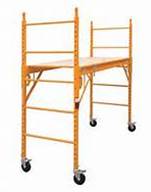
Baker Type - easily transportable - narrow in design - if on casters, can be moved manually |
|
|
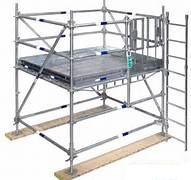
Tube and Coupler
Type -
system using tubes for posts,
bearers, braces, and ties -
special couplers connect the parts -
casters may be used |
|
||
|
|
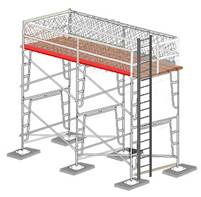
Tubular Welded
Frame - system using
prefabricated, welded sections that serve as posts and horizontal bearers - deck can be
built with (stamped) scaffold-grade lumber or manufactured deckboards
spanning the end-frames |
|
Refer
to 6131, Fall Protection
Systems for non-scaffold fall protection options for construction
activities at four feet or higher; or whenever a person works above dangerous
machinery or operations.
This appendix is written in coordination with 6132, Ladder and Scaffold Safety. All applicable content within the chapter applies to the process steps outlined in this appendix.
Note: Management authority may be delegated to a
task-qualified TJNAF employee at the discretion of the responsible manager.
Training:
Contact the Industrial Safety Group for
questions regarding ladder and scaffold safety training.
3.1 Scaffold Worker
· Obtain authorization for scaffold use from the appointed Competent Person – Scaffold.
· Notify your supervisor or technical representative of any health conditions or medication that would affect the safe use of scaffolding.
· Wear appropriate personal protection equipment (PPE) when assembling, using, and disassembling scaffolding.
· When authorized, erect and disassemble scaffolding in accordance with manufacturer’s specifications and Jefferson Lab requirements.
3.2 Competent Person – Scaffold
· Complete applicable training or equivalent
· Ensure assigned scaffold worker(s) is trained and/or qualified.
·
Ensure scaffold worker(s) is appropriately
briefed and/or authorized.
·
Provide scaffold workers with the hazard mitigation training associated with the
assigned scaffold.
·
Plan, select, inspect, and maintain scaffold
equipment in accordance with manufacture’s specifications and Jefferson Lab
requirements.
·
Explain
the erection procedure to scaffold workers.
·
Monitor
scaffold erection.
·
Inspect
completed structure before initial use and daily thereafter.
·
Address
personnel questions or concerns regarding the construction and/or safety of the
scaffolding
3.3 Supervisors and Technical Representatives (TR)
· Schedule Competent Person – Scaffold for applicable training; or obtain documentation of the worker’s equivalency qualifications and submit for approval, from Industrial Safety prior to erection and/or work with scaffolds.
· Assign a Competent Person – Scaffold for the duration of the scaffold work.
· Review scaffold safety requirements with workers in area.
· Coordinate with Occupational Medicine if health conditions or medication prevents a worker from using the scaffold.
· Ensure scaffolding is selected, used, and stored in accordance with manufacturer’s and Jefferson Lab’s requirements.
· Review and, if adequate, accept equivalent training qualification documentation, or
· Train workers in appropriate scaffold erection, use, and disassembly.
Unless otherwise stated authorized scaffold workers, assigned tasks on behalf of Jefferson Lab, may perform the process steps outlined below.
·
Consider
the following when planning work that will require scaffolding:
o duration and type of work to be
performed
o location
o scaffold
limitations and/or intended use specifications
o load rating must be able to sustain
at least four times the maximum intended load
o maintenance
requirements
o material hoist method
o fall protection needed
o weather and environmental
conditions
o rescue equipment (particularly for
suspended scaffolds)
o address any wind loading concerns
for outdoor scaffolds
·
When
moving vehicles are present in work area, scaffolding is marked conspicuously
with ropes or barricades.
·
Ensure
a ladder, or equivalent safe access method, can be provided to all levels. (The
cross-braces of a scaffold frame are not
designed to be used for access.)
·
Tool,
material, and debris containment so objects do not drop from a scaffold.
·
Castor
wheel brakes engagement. (Factor
adequate spacing to allow for engagement at all times, except when movement is
required.)
4.3
Personal Protective
Equipment (PPE)
·
Minimum
PPE required is a hardhat, safety glasses and steel-toed shoes
·
Additional
PPE for the specific tasks as identified via a Task Hazard
Analysis (THA).
All fabricated tubular frame
scaffolds (stationary or rolling) are required to be erected and dismantled
under the supervision of a Competent Person - Scaffold. This person:
·
ensures
the correct scaffold system is used
·
explains
the erection or dismantling procedure
·
monitors
erection and dismantling activities
·
inspects
completed structures before initial use and daily thereafter
Scaffolding
is erected in accordance with the owner’s manual instructions as authored by
the applicable manufacturer. Do not
interchange different manufacturers’
components unless they are compatible with the structure and provide additional
structural integrity.
·
Scaffold is inspected after assembly, prior to
initial use, and before each shift thereafter by the competent person. Use the Scaffold
Inspection Checklist.
·
Completed
inspection checklists are signed and dated by the competent person and attached
to the scaffold. When the scaffold is disassembled, the forms need to be sent
to the ES&H Division’s SME for filing and storage.
·
Completed
forms are to be stored for one year and then disposed of.
4.6
Repair and Maintenance
on scaffolding may be requested by anyone at Jefferson Lab. Safety color
sheets should be used to label scaffolds with the applicable status when
they are being repaired and/or are under maintenance.
·
Place the scaffold out-of-service by using the
red Do Not Use sign or tag. If updates are being made to the
scaffold or it is being inspected for use, select the yellow Caution
sign or tag.
·
Contact
the Competent Person to determine repair and maintenance requirements, or
request alterations to the scaffold.
·
Upon
completion of repairs, the scaffold is re-inspected and approved for use in
accordance with 6132,
Appendix T4: Scaffold Inspection Procedure.
·
Upon
completion of an acceptable inspection the lock/tag is removed and work may continue.
When placing the scaffold back into service, use the green Safe-to-use sign or tag.
Use
an adequate foundation (solid dry
ground, concrete, or asphalt) that supports the load of the scaffold,
materials, equipment, and workers without collapsing or shifting. Screw-jack
levelers are recommended. When the ground is soft and cannot support the load
use mudsills (lumber) to spread the load of the base plate and legs of the
scaffold.
·
Rolling
scaffolds may only be used on level, firm surfaces.
·
Do not use unstable (or crushable) objects
such as barrels, boxes, loose brick or concrete blocks to support the scaffold
or planks.
·
Scaffold
frames must be level and plumb.
·
Cross
braces are used at every frame pair, and locked in place.
·
If
uplift is possible, floor decking must be secured by pins, guys, wires, or
other equivalent means.
Platforms
must be completely planked. Gaps < 1 inch are allowed except where scaffold
uprights interfere or as necessary for an entrance opening.
·
Fabricated
scaffold decks must be labeled for the working load and used accordingly.
·
Sawn
lumber:
o
Must
be stamped scaffold plank grade and
selected for the working load, or selected by Industrial Safety to meet the
intended load requirements
o
May
not be painted (this conceals knots and other defects)
·
If
planking must overlap end-to-end and cannot be secured, a minimum of 12-inch
overlap is needed. Any overlap must be centered over an intermediate support.
·
At
end supports, planks must have an overhang of 6 to 12 inches unless cleats or
hooks are used to prevent planks from sliding. Never exceed 12 inches of
overhang.
·
Platforms
do not deflect more than 1/60 of the span when loaded.
·
Minimum
platform width is 18 inches.
Guardrails are required on all open
sides and ends of platforms whenever there is a drop of more than four
feet.
·
Must
be greater than 5 x 10 cm (~2 x 4 inch) cross sections, and 0.9 to 1.1-meters
(~36 to 42 inches) high. (Diagonal or X-bracing can only be used in some
specific situations.)
·
Cross
bracing is acceptable as a complete guardrail system if the crossing point is
between 31 and 48 inches above the platform and the ends are no more than 54
inches apart.
·
Cross
bracing is acceptable as a single guard rail if it is at least 20 inches and no
more than 30 inches above the platform.
·
You
do not need guardrails if:
o
scaffold
covers the entire interior of the building or room wall-to-wall
o on sides or ends with < 16-inch
gap to the building wall
·
Must
be within 38 to 45 inches above the platform.
·
Must
be supported at least every 10 feet.
Toe boards are required for open
sides more than three meters (~10-feet) off the ground or floor. They are
primarily intended to be a barrier to prevent tools or materials from being
knocked off the scaffold:
·
Must
be at least 4 inches (10 cm) high and have a snug fit to the platform along
their length
·
Made
of 2 x 4 lumber or the equivalent
A screen is required between the
top rail and toe board if material is stacked higher than the toe boards, or if
people work or pass beneath the scaffold. Mid rails may be omitted if a screen
is used.
·
Use
18 gage, ½-inch wire mesh or equivalent.
5.8
Tipping Restraints (Wall Ties)
Used with free-standing scaffolds
with a height-to-base ratio > 4:1*.
·
Vertical Wall Ties at the 4:1 elevation point and every 26-feet
thereafter
·
Longitudinal Wall Ties at each end and at 30-foot intervals
|
*Notes
|
Ensure
it is in good condition and graded to support at least six times the intended
load.
·
Conventional
straight ladders, Type I or IA, secured to the scaffold, extending three feet
past the platform.
·
Hook-on
ladders made for this purpose.
·
Stair
assemblies made for the scaffold system.
·
The
scaffold frame itself may be used if:
o
maximum
rung spacing is no more than 16 3/4 inches vertically.
o rung width is at least 12 inches
horizontally.
·
Casters
o
Roll
and swivel freely
o
Have
working brakes
o
Are
affixed to the leg
·
Casters
are locked except during intentional moving.
·
When
moving
o
Remove
workers, material, and/or equipment from platform(s).
o
Ensure
there are no pits, holes, or obstructions along the path.
o
Unlock
casters or brakes.
o
Apply
force as close to the base as possible.
·
Re-lock
the casters/brakes immediately after the move.
6.0
Revision History
|
summary |
date |
|
|
2.0 |
periodic review · added Note and
Training statement to Section 3.0 · Sections 4.0 and
5.0, updated wording throughout · Section 6.0,
updated header to Revision History and changed to this tabular format · throughout:
corrected misspellings; changed scaffold inspection frequency from daily to
before each shift; updated SOTR to TR; fixed acronyms and abbreviations as
needed · changed TPOC from
BManzlak to RKenney · general editing
to include format, header & footer (+color), hyperlinks, cross-references,
etc. by JAllen, ES&H Manual Editor |
12.06.2023 |
|
|
period
review - no changes
per TPOC |
10.25.2018 |
|
1.2 |
periodic
review - minor procedural revisions re: CATS
MOA-2015-02-16-01; review cycle adjusted to reflect high risk category |
11.04.2015 |
|
1.1 |
updated graphics, description, and training to more
accurately reflect scaffolds used at Jefferson Lab; changed TPOC from NWalker
to BManzlak |
01.30.2014 |
|
1.0 |
updated to reflect current laboratory operations |
06.07.2010 |


