|
|
TITLE |
||
|
|
|||
|
DOCUMENT ID |
6141 Appendix T3: Inspection Procedures -
Overhead and Mobile Cranes,
Hoists, and Rigging |
||
|
|
|||

Jefferson Lab requires routine inspection and regular
maintenance of overhead cranes, hoists and rigging used on its behalf. ES&H Manual Chapter
6140 Appendix T3 Inspection and Maintenance Procedure for Material Handling
Equipment provides the minimum requirements for all material handling
equipment. It is based on Occupational Safety and
Health Administration (OSHA) and the American Society of Mechanical Engineers (AMSE)
national standards.
Additional requirements specific to
overhead and mobile cranes, hoists, and rigging are provided below.
This appendix defines additional inspection requirements
for:
·
Cranes, hoists, below-the-hook
lifting devices (BTHLD), and rigging equipment
owned or leased by Jefferson Lab.
·
Subcontractor provided
cranes, hoists, and rigging.
It is written in coordination with ES&H Manual Chapter 6140 Material Handling Equipment Program and ES&H Manual Chapter 6141 Material Handling – Rigging, Cranes, and Hoists. All applicable content within these chapters applies to the process steps outlined in this appendix.
Note: Management authority may be delegated to a
task-qualified TJNAF employee at the discretion of the responsible manager.
3.1
Qualified
Crane and Hoist Operator – includes
anyone approved to use a crane/hoist on behalf of Jefferson Lab.
· Conduct an inspection of the
crane/hoist and rigging before beginning a job.
Perform inspection of wire rope in accordance with Jefferson Lab requirements (see Section 4.3 Wire Rope).
3.3
Supervisors
and Technical Representatives (TR)
· Monitor rigging operations daily.
· Ensure operators perform required
inspections of crane/hoist and rigging equipment in use as trained.
· Annually, identify all material
handling equipment needing an Annual Inspection. The equipment shall be tagged
or identified so, the inspector can easily identify the equipment needing an
annual inspection.
· Remove unnecessary equipment from service. Contact the MHM to
have equipment removed from service.
· Request equipment be placed back in service that is out
service. Contact the MHM to have equipment placed back in service.
3.4
Material Handling Manager (MHM)
· Designate primary “wire rope”
inspectors. Ensure Annual Periodic Wire Rope Inspections are performed by a
qualified person.
· Periodically review operator’s
performance during required inspections of cranes/hoists and rigging equipment
in use.
· Maintain annual and periodic inspection
records.
4.0
Equipment Inspections and
Inspection Tags
4.1
Annual
Inspection Tags (required
on certain pieces of Jefferson Lab owned material handling equipment)
·
Annually, certain pieces of rigging equipment, “in service”,
require inspection and documentation by a qualified person.
·
Annual Inspection tags are required on
the following equipment: cranes, manual hoists, electric hoists, lever hoists,
below-the-hook-lifting devices, chain slings.
·
Annual Inspections are performed by a designated and qualified
person or by a qualified subcontract service as determined by the MHM.
·
Annual inspection tag colors will change from year to year.
·
Inspection tags consist of a unique color-coded tag. The tag
indicates the inspector’s initials and the date the annual inspection was
performed.
·
Equipment with
a current annual inspection tag means; the equipment was satisfactory, only, at
the time the annual inspection was performed. This tag does not release the
operator from his obligation in performing his, Frequent/Pre-use/Pre-operational,
inspection immediately before use of the equipment each day as trained in SAF
403.
·
Equipment may be used for up to one (1) year according to
the date of inspection written on the annual inspection tag by the equipment
inspector.
·
If the equipment is annually inspected, by the MHM or his
designee, on behalf of Jefferson Lab, the tag is the record of inspection in
lieu of records.
·
If the annual inspection survey reveals the equipment is not
suitable for use, the equipment shall be removed from service by the designated
inspector. The equipment will not receive an annual inspection tag if the
equipment is not suitable for use.
·
Equipment missing the Annual Inspection tag shall not be used.
The person needing use of the equipment shall assume the equipment is not in
service.
·
Equipment with an illegible date on the annual inspection
tag shall not be used.
·
Contact the MHM for any questions regarding annual
inspection tags and hoisting or rigging equipment.
·
Subcontractors are excluded from this tagging requirement.
Subcontractors are responsible for ensuring their hoisting equipment is in
proper working order before use. The MHM or his designee visually inspects all
subcontractor owned equipment before use on behalf of Jefferson Lab.
|
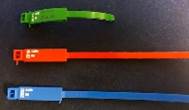
Examples
of Annual Inspection Tags |
|
|
|
|
|
|
|

4.2
Out
of Service & Do Not Use Tags
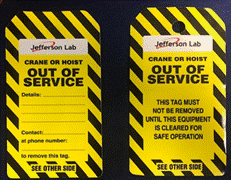
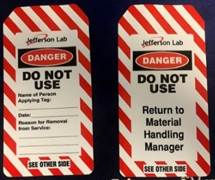
· Equipment may be removed from service
by one of the tags shown below for various reasons.
·
Crane, hoists or other related handling equipment, tagged with
one of the tags shown below, shall not be used if found on the equipment.
|
Sample Crane or Hoist OUT OF SERVICE |
|
Sample DO NOT USE |
|
|
|
|
|
|
|
used for all other related material
handling equipment |
|
|
|
4.3 Daily Equipment Operability Determination (the daily pre-operational inspection results in one of the following determinations for the equipment’s status):
· Check the Annual Inspection Tag (Only if hoisting equipment requires an annual inspection tag.) – To determine if the equipment is “In Service” or “Out of Service” in accordance with Sections 4.1 and 4.2 of this document.
· The operator’s pre-operational inspection is satisfactory – continue with work plan.
· The operator’s pre-operational inspection is unsatisfactory and it requires a more detailed
inspection – one/some/all items may be defective:
o Remove from the equipment from service – Lock the machine out of service
if appropriate or tag the equipment out of service.
o Notify your supervisor.
o Immediately contact the MHM.
4.4
Overhead and Gantry Cranes
· Daily & Preoperational
Checks (records
are not required if equipment is found “Satisfactory for Use”):
o Daily inspection is mandatory before
the crane is used for the day.
o The qualified operator, or other
designated task qualified person, visually inspects for:
–
Maladjustments that may interfere with proper operation – check all
functional operating mechanisms
–
Deterioration or leakage – check all lines, tanks, valves, drain
pumps, and other parts of air or hydraulic systems
–
Damage from chemicals– check all hooks for cracks, deformation, or
latch disengagement.
–
Significant wear, kinking, crushing, bird-caging, corrosion, or
broken strands and wires – check hoist rope
–
Excessive wear, twists, distorted links interfering with proper function,
or stretch beyond manufacturer’s recommendations – check hoist chains,
including end connections
–
Proper operation – check primary hoist upper-limit device
o Performed
in accordance with the applicable ASME
B30 standard and OSHA regulations.
o The MHM annually inspects and/or designates a “task qualified person” to perform a complete inspection of cranes and hoists that were identified needing an inspection by the supervisor/manager in the area of responsibility. These inspection services may be provided by a subcontractor who has been determined to be qualified by the MHM.
o Upon completion an inspection a report is provided to the MHM detailing the condition of the equipment for inspections completed by a subcontractor.
o Inspection reports for each crane are maintained by the MHM.
o Detachable hoists or unsecured hoists are inspected annually by the MHM or his designee. The unique external color-coded mark is the record of inspection in lieu of records.
The running rope on hoists receives a monthly visual inspection, if the crane is accessible. Running rope that is inaccessible for longer than a month receives an inspection prior to first use. This inspection is performed using the following steps:
Step 1: Lower the hook to a position immediately above the floor.
Step 2: Visually inspect the entire length of the wire rope for gross damage, including:
· Distortion of the rope such as kinking, crushing, unstranding, birdcaging, main strand displacement or core protrusion.
· General corrosion.
· Broken or cut strands.
Step 3: Inspect the hook and the sheaves of the hook block.
Step 4: If damage is found or suspected:
· Raise the hook to an intermediate position.
· Apply an administrative lock and tag with the electrical disconnect in the OFF position.
· Immediately contact the MHM to conduct a thorough rope inspection.
Alternate Step 4: If no damage is found or suspected:
· Raise the hook to the fully raised position.
Step 5: Upon completion of the monthly inspection, certify that it was completed on the “Wire Rope Inspection Record” located near the crane (generally at the electrical disconnect). Report any unusual observations to the MHM.
Table
1 Wire Rope Inventory
|
BUILDING - ROOM |
TYPE |
CAPACITY # |
BRIDGE TAG |
MFR. & SERIAL No. |
Designated Primary Inspector |
|
8 CHL I Compressor |
Top Running Bridge |
10,000 |
F2-6367 |
Reliable #26357 |
Engineering Division Bill Hunewill |
|
8 CHL West Addition |
Top Running Bridge |
10,000 |
F7-1560-00 |
VA Crane #VC98-917 |
Engineering Division Bill Hunewill |
|
8 CHL II |
Single Girder Top Running |
10,000 |
FMH-001425 |
Michigan Crane 09-5035 |
Engineering Division Bill Hunewill |
|
36 GPB |
Single Girder Top Running |
20,000 |
FMH-001419 |
VA Crane VC10-1740 |
Engineering Division Mike Beck |
|
36 GPB |
Single Girder Top Running |
10,000 |
FMH-003851 |
Piedmont 6100309-1 |
Engineering Division Mike Beck |
|
36 GPB |
Single Girder Top Running |
10,000 |
FMH-003852 |
Piedmont 6100309-2 |
Engineering Division Mike Beck |
|
38 S. Access |
Double Girder Top Running |
Hoist #1 15,000 |
F2-6361 |
VA Crane #VC89-327 |
Engineering Division Mark Loewus |
|
38 S. Access |
Double Girder Top Running |
Hoist #2 15,000 |
F2-6361 |
VA Crane #VC89-327 |
Engineering Division Mark Loewus |
|
53 Injector SB |
Monorail |
6,000 |
F2-17947 |
VA Crane |
Engineering Division Mark Loewus |
|
55 TED High Bay |
Double Girder Top Running |
40,000 |
CXTD10-Ton |
Konecrane |
Engineering Division Jay Noble |
|
58 High Bay North |
Double Girder Top Running |
50,000 |
F2-2750 |
VA Crane #VC87-231 |
Accelerator Ops, R&D Tom DeSalvo |
|
58 High Bay South |
Double Girder Top Running |
50,000 |
F2-2725 |
VA Crane #VC87-230 |
Accelerator Ops, R&D Tom DeSalvo |
|
67 N. Access |
Double Girder Top Running |
Hoist #1 15,000 |
F2-6363 |
VA Crane #VC89-326 |
Engineering Division Mark Loewus |
|
67 N. Access |
Double Girder Top Running |
Hoist #2 15,000 |
F2-6363 |
VA Crane #VC89-326 |
Engineering Division Mark Loewus |
|
90 101-EEL |
Underhung Bridge |
10,000 |
F2-6366 |
VA Crane #VC90-361 |
Engineering Division Dave Meekins |
|
90 127-EEL |
Underhung Bridge |
10,000 |
F2-6365 |
VA Crane #VC90-362 |
Experimental Nuclear Physics David Wallace |
|
94 Hall B |
Double Girder Top Running Polar |
40,000 |
|
VA Crane #VC91-475 |
Experimental Nuclear Physics Hall B Coordinator |
|
96 Hall C |
Double Girder Top Running Radial |
40,000 |
|
VA Crane #VC91-476 |
Experimental Nuclear Physics Hall C Coordinator |
|
101 Hall A |
Double Girder Top Running Radial |
40,000 |
|
VA Crane #VC91-474 |
Experimental Nuclear Physics Hall A Coordinator |
|
104 ESR-II |
Double Girder Top Running |
6,000 |
FMH-003858 |
Deeborn |
Engineering Division James Davenport |
|
203 Hall D |
Double Girder Top Running |
40,000 |
FMH-003859 |
Hoist & Crane Sys. |
Experimental Nuclear Physics Hall D Coordinator |
4.6
Slings
Pre-use Inspection – Prior to each use slings are inspected for
acceptable condition in accordance with DOE
Standard 1090-2007: Hoisting and Rigging Standard Chapter 11 WIRE ROPE AND
SLINGS by the user:
· Section 11.3 – General Information
· Section 11.3.2 – Wire-Rope Slings
· Section 11.3.3 – Alloy Steel-Chain Slings (Requires Annual Inspection Tag)
· Section 11.3.4 – Metal-Mesh Slings (Requires Annual Inspection Tag)
· Section 11.3.5 – Synthetic-Web Slings
· Section 11.3.6 – Synthetic Roundslings
4.7
Rigging
Accessories Pre-use Inspection – Prior to each use, rigging devices are
inspected for acceptable condition in accordance with DOE Standard 1090-2007: Hoisting and Rigging Standard Chapter 12 RIGGING ACCESSORIES
by the user:
· Section 12.1 – General Information
· Section 12.2 – Rigging Hooks
· Section 12.3 – Shackles
· Section 12.4 – Eyebolts
· Section 12.5 – Eye Nuts
· Section 12.6 – Turnbuckles
· Section 12.7 – Links, Rings, and Swivels
· Section 12.8 – Swivel Hoist rings
· Section 12.9 – Load Indicating Devices
· Section 12.10 – Precision Load Positioners
· Section 12.11 – Compression Hardware
4.8
Load
Hooks Pre-use Inspection – Prior to each use, and at specific
intervals, load hooks are inspected for acceptable condition in accordance with
DOE Standard 1090-2007: Hoisting and
Rigging Standard Chapter 13 LOAD HOOKS:
· Section 13.1 – General Information
· Section 13.2.3 – Daily Inspection
· Section 13.2.4 – Frequent Inspection (monthly)
· Section 13.2.5 – Periodic Inspection (yearly)
o
The MHM annually designates a “qualified person” to perform a
complete inspection of crane load hooks. These inspection services may be
provided by a subcontractor who has been determined to be qualified by the MHM.
o
Upon completion an inspection report is provided to the MHM
detailing the condition of the load hook.
o
Inspection reports for each load hook are maintained by the MHM.
4.9 Below the Hook Lifting Devices (BTHLD) Pre Use Inspection – Prior to each use, BTHLD’s are inspected for acceptable condition in accordance with DOE Standard 1090: Hoisting and Rigging Standard Section 12 BELOW-THE-HOOK LIFTING DEVICES & Section 13 MISCELLANEOUS LIFTING DEVICES :
o
The MHM annually inspects or designates a “qualified person” to
perform a complete inspection of each device as necessary. These inspection
services may be provided by a subcontractor who has been determined to be
qualified by the MHM.
o
Upon completion an inspection survey, an inspection tag is placed
on the BTHLD if the inspection survey was satisfactory. The BTHLD is removed from service, by tagging
the equipment “out of service”, if the inspection reveals a discrepancy with
the item in accordance with Section 4.2
-Out of Service or Do Not Use Tags of this document.
o
The unique color-coded inspection tag is the record of inspection.
o
The Person-in-Charge (PIC) is responsible for ensuring the BTHLD has
a current periodic/annual inspection before use of the BTHLD each time before
use. Verify the unique color-coded tag
is current in accordance with SECTION
4.1 of this document.
o
Contact the MHM to have any BTHLD in need of an inspection before
use anytime.
4.10 Miscellaneous Lifting Devices[1] Pre-use Inspection – Prior to each use miscellaneous lifting equipment is inspected for acceptable condition by the user in accordance with DOE Standard 1090: Hoisting and Rigging Standard Section 13 MISCELLANEOUS LIFTING DEVICES.
[1] Miscellaneous Lifting Devices includes: portable A-frame (aka portable
gantry), Truck mounted cranes with a capacity of 1 ton or less, self-contained
shop cranes (aka engine hoist), and pallet jacks.
4.11 Construction Site Mobile Crane and Rigging Inspection
Inspections of mobile cranes used on Jefferson Lab construction sites are primarily controlled in accordance with a Jefferson Lab approved Material Handling Lift Plan. The goal of an inspection is to verify that the crane owner follows the requirements of ASME B30.5 MOBILE AND LOCOMOTIVE CRANES and OSHA 29 CFR 1926 Construction Industry Regulations, 1926 Subpart CC –Cranes & Derricks in construction. If the inspection reveals that the requirements are not met, the machine is rejected and cannot be used at Jefferson Lab pending repair or replacement, and re-inspection.
Step 1:The MHM, or designee, inspects the mobile crane and rigging equipment upon arrival at the job site, prior to use.
Step 2:Inspector denotes on the Lift Plan that the following has been reviewed and meets the safety requirements of the referenced standard(s)[2]:
· Crane’s Annual Inspection document
· Crane’s Daily Inspection record
· Crane’s Monthly Wire Rope Inspection record
· Crane’s Quadrennial Load Test Certificate if available, however not required.
Step 3: Inspector reviews the credentials of the crane operator, the lead rigger and the signal person and records the qualifications on the Lift Plan.
· Crane Operator – must possess a document that satisfies the requirements of OSHA 1926.1427. An acceptable document is generally a qualification card issued by NCCCO; however, other qualification organizations may be acceptable.
· Lead Rigger (Qualified Rigger) – must meet the “Qualified Person” definition in OSHA 1926.1401. Many riggers do possess a training card. The quality of the lift plan is the best indication that a knowledgeable rigger has been involved.
· Signal Person – must meet the “Signal Person” requirements of OSHA 1926.1428(c). Many riggers do possess a training card. The company the Signal Person works for is required to maintain these training records on the construction site.
Step 4:The MHM inspects the rigging gear provided with the mobile crane or other subcontractors involved with the planned lift. Slings and rigging hardware are inspected using:
·
ASME B30.9 SLINGS
· ASME B30.26 RIGGING HARDWARE
· OSHA 29 CFR 1926 Construction Industry Regulations, 1926.251 – Rigging Equipment for Material Handling
5.0
References
·
DOE-STD-1090: Hoisting and Rigging Standard
(Formerly Hoisting and Rigging Manual)
·
ASME B30.9 SLINGS
·
ASME B30.26 RIGGING HARDWARE
·
ASME B30.5 MOBILE AND
LOCOMOTIVE CRANES
·
OSHA 29 CFR 1926 Subpart CC – Cranes & Derricks
in Construction
·
OSHA 29 CFR 1926 Construction Industry
Regulations, 1926.251 – Rigging Equipment for Material Handling
·
OSHA 29 CFR 1926 Construction Industry
Regulations, 1926.753 – Hoisting and Rigging
6.0
Revision Summary
Revision 1.7 – 03/30/22 – Added Note to 3.0; removed triennial inspection tag requirement (4.2 section) and some hyperlinks; made minor editorial changes to reflect current site practices; revised header and footer formats
Revision 1.6 – 04/21/20 – Updated to include a process integrating hoists not permanently attached to crane structures, including inspection requirements per CATS#INSP-2019-001-01-01
Revision 1.5 – 01/01/18 – Updated TPOC from B.Sperlazza to M.Loewus; updated Wire Rope Inspection Report Form
Revision 1.4 – 02/09/17 – Updated TPOC
from D.Kausch to
B.Sperlazza per B.Sperlazza; updated Wire Rope Inspectors in Table 1 and added
the primary inspectors Division.
Revision 1.3 – 12/17/15 – Eliminated two positions previously identified as the MHSR and the MHER, the responsibilities of these positions are now performed by the MHM. Updated Wire Rope Inventory inspector for the Machine Shop Crane (was Mike Powers) and deleted the Test Lab Boiler Room crane.
Periodic Review – 12/04/14 – No changes
Revision 1.2 – 02/04/14 – Updated Wire Rope Inspector in Table 1 from C.Hightower to D.Kausch per D.Kausch
Revision 1.1 – 11/20/13 – Periodic Review; updated to reflect current laboratory operations and incorporate language from new OSHA1926 Subpart CC per D.Kausch
Revision 1.0 – 04/12/12 – Updated to
reflect current laboratory operations




|
|
ISSUING
AUTHORITY |
TECHNICAL
POINT-OF-CONTACT |
APPROVAL
DATE |
REVIEW DATE |
REVIEW
CYCLE |
rev |
|
|
|
ES&H Division |
04.21.2020 |
03.30.2022 |
3 years |
1.7 |
|