|
|
TITLE |
||
|
|
|||
|
DOCUMENT ID |
6141 Appendix T6: Below-the-Hook
Lifting Devices |
||
|
|
|||

At Jefferson Lab below-the-hook lifting devices (BTHLD) are designed, built, and purchased to perform specific functions. This appendix outlines the requirements for the design, production, use, and modification of said devices.
Devices that have not met the requirements of this procedure must be presented to the Material Handling Manager (MHM) for inspection, testing, and/or appropriate use determination.
A BTHLD is not to be used without an appropriate name plate or other permanent marking; nor for anything other than its intended purpose.
The procedures below are to be performed in conjunction with Chapters 6140, Material Handling Equipment Program and 6141, Rigging, Cranes, and Hoists Material Handling Equipment.
Note: Management authority may be delegated to a
task-qualified TJNAF employee at the discretion of the responsible manager.
3.1 Material Handling Manager (MHM)
· maintain records for all approved BTHLD at Jefferson Lab
· ensure a load test is performed on all BTHLDs in accordance with DOE Standard 1090-Hoisting and Rigging Standard; Section 12- Below-the-Hook Lifting Devices
3.2 Qualified Engineer: designs and produces BTHLDs in accordance with the provisions of ASME B30.20, ASME BTH-1 and TJNAF requirements
3.3 BTHLD Custodian: ensure BTHLD under your authority are maintained, inspected, and used in accordance with this procedure
Specific responsibilities are highlighted within the procedures below.
It is recommended that the MHM be contacted prior
to commencement of this procedure. Several BTHLD are available in storage which
may be adequate for your operation.
4.1.1
Submit BTHLD Design to
Appropriate Engineering Department
·
Submit a draft BTHLD design concept, or description of
requirements, to the engineering department.
·
An engineering drawing is developed by a qualified engineer to
comply with ASME B30.20, ASME BTH-1, and per department
procedures. Refer to Welding and Brazing Program
Supplement.
·
The drawing is reviewed and signed by a second qualified engineer.
4.1.2
Submit Drawing to MHM
for Approval

·
The Engineer-of-Record starts a Material Handling Device
Engineering Note, and submits the note and reviewed drawing to the MHM for
approval.
·
The MHM reviews, and if found to be appropriate, approves the
drawing for production.
o they retain the note and
a copy of the approved drawing on file; and,
o returns the approved
drawing to the Engineer-of-Record.
Unless otherwise stated the Engineer-of-Record is
responsible for this portion of the procedure.
4.2.1
Fabrication
·
Assign production of the BTHLD to an in-house fabricator, or a
qualified vendor in accordance with 6140, Appendix T2: Procurement of Material Handling Equipment.
·
Ensure it is produced in accordance with drawing specifications.
4.2.2
Approve for Use
· Schedule a Load Test with the MHM or designee. The load test is to be performed in accordance with ASME B30.20-Below-the-Hook-Lifting Devices.
·
Upon completion of satisfactory test, MHM will provide a label
(see Section
4.5 Labeling below) designating approval for use.
(In accordance with 6140, Appendix T2: Procurement of Material Handling Equipment.)
·
Prior to acceptance of the item, schedule a review with the MHM.
Acceptance criteria includes:
o a qualifying Load Test
has been performed, and
o item has been properly
labeled
|
Upon successful completion, or confirmation, of a qualifying
load test and acceptable labeling, the BTHLD custodian may take ownership of
the device. |
4.3
Maintenance,
Inspection, and Use
The BTHLD
Custodian is responsible for the following:
·
Ensure BTHLD is maintained in usable condition per department
procedures.
·
Perform appropriate inspections prior to each use. Refer to 6141, Appendix T3: Overhead & Mobile Cranes, Hoists, and
Rigging Inspections.
·
Ensure the BTHLD is used only for its intended purpose.
·
Ensure the BTHLD has a current annual inspection/periodic
inspection tag on the device before use in accordance with 6141, Appendix T3,
Section 4.0.
TJNAF recognizes that from time to time a BTHLD may require
repair, modification, or be assigned a task other than for its intended
purpose. When this happens it must be designed, reviewed, approved, and
produced as if it were new.
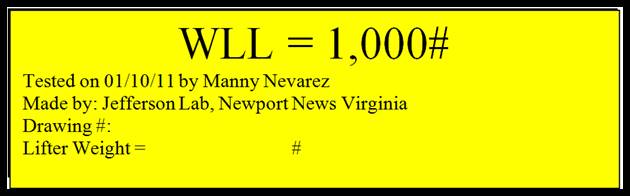
If produced in-house the following
label (example) is attached to, or otherwise denoted on, the device.
Example
of Approved BTHLD Label
If Produced
by Outside Vendor at a minimum, the
following information is required to be attached to, or otherwise denoted on, the
device:
·
Manufacturer’s Name
·
Manufacturer’s Address
·
Serial Number
·
Lifter Weight, if over 100 lbs (45 kg)
· Rated Load
5.0
Revision History
|
summary |
date |
|
|
0.6 |
minor
edits, removed some hyperlinks updated
Note in 3.0; general formatting changes including updating 5.0 to tabular
format |
03.30.2022 |
|
0.5 |
replaced
ESH&Q with ES&H; updated contact information; other minor edits no
approval needed |
02.24.2021 |
|
0.4 |
updated
TPOC from BSperlazza to MLoewus |
01.24.2018 |
|
0.3 |
updated
TPOC from DKausch to BSperlazza per BSperlazza |
02.09.2017 |
|
0.2 |
eliminated
two positions previously identified as the MHSR and the MHER, the
responsibilities of these positions are now performed by the MHM; modified
the BTHLD Label to contain all required data |
12.18.2015 |
|
|
periodic
review – no changes per TPOC |
12.04.2014 |
|
0.1 |
updated
weblinks |
03.22.2012 |
|
0.0 |
new
content |
10.21.2011 |




|
|
ISSUING
AUTHORITY |
TECHNICAL
POINT-OF-CONTACT |
APPROVAL
DATE |
REVIEW DATE |
REVIEW
CYCLE |
rev |
|
|
|
ES&H Division |
01.24.2018 |
03.30.2022 |
3 years |
0.6 |
|