The
purpose of this document is to define the requirements for safe operations of
low lift and high lift forklifts used on behalf of Jefferson Lab.
This document provides Jefferson Lab’s
minimum requirements for safe operation of forklifts and attachments.
Requirements are provided in coordination
with ES&H Manual Chapter 6140 Material
Handling Equipment Program and ES&H Manual Chapter 6145 Material Handling Equipment –
Forklifts and Attachments.
3.0
Responsibilities
NOTE: Management authority may be delegated to a task
qualified Jefferson Lab employee at the discretion of the responsible manager.
3.1
Qualified Forklift Operators
·
Perform a Pre-Work Analysis prior to forklift
operations.
·
Determine the need for Guides or Signalers
·
Perform work in accordance with Forklift Operations
Guidelines listed below including:
o
Attaching rigging to the forks to support a suspended load
o
Performing Critical
Lifts
o
Operating in tunnels and halls or other tight-clearance areas
Refer to
ES&H Manual Chapter
6140 Material Handling Equipment Program and ES&H Manual Chapter 6145
Material Handling Equipment – Forklifts and Attachments for overall
responsibilities.
·
Familiarize yourself
with the area of operation noting any unusual conditions by performing a Task Hazard Analysis and documenting unusual conditions as
required.
·
Select the proper forklift
for the job; diesel/propane or electric powered forklift. (For example: Indoor
use of diesel/propane forklifts is kept to a minimum. They may be used to move
a load in or out of a building, but not within a building.)
·
Evaluate the driving surface and tire-type:
o
Pneumatic-type tires:
asphalt, concrete, or improved (graveled).
o
Solid-type tires: asphalt
or concrete surfaces.
·
The need for guides and signalers is identified through the Task Hazard Analysis and determined by load size or proximity of hazards.
However an operator can request this type of assistance at any time.
·
Must be in the operator’s
view at all times.
·
Remain away from the
raised load. Guides and signalers maintain a distance of at least one foot from
the load for every foot the load is raised.
·
Hardhats are worn by operators, guides, and
signalers when the forklift operation involves lifting the load more than
six-feet above the floor.
·
Forklifts are not operated
on public highways beyond the Jefferson Lab site boundaries.
·
Operators, guides and signalers concentrate on the operation of the forklift and the load. The
work must be stopped if a distraction is present.
·
Electric forklifts are charged in approved charging areas which
have an eye wash station located nearby.
·
At the conclusion of the forklift operation, the operator
immediately restores the work area to its pre-work condition, replacing
barriers, ropes, or other items moved for travel or delivery of the load.
|
The following sections are transcribed from DOE
Standard 1090-2011; Hoisting and Rigging Standard, Chapter 10 Forklift
Trucks. Paragraph numbering used in this Reference has been retained for ease
of future updates. Portions of the Operators Conduct that do not apply at
Jefferson Lab have been omitted as noted.
|
The following shall apply to all personnel
involved in forklift operations. At the initial stage of the planning process,
an appointed person shall classify each lift into one of the DOE-specified
categories (ordinary, critical, or preengineered production).
Note:
Preengineered Production lifts are not defined for Jefferson Lab material
handling operations. A Standard
Operating Procedure or Temporary Operational Safety Procedure will be used as
apropriate for forklift operations that are beyond the scope of an ordinary
lift.
10.5.1 CONDUCT OF OPERATOR
The following requirements shall be
observed by the operator when operating forklift trucks.
10.5.1.1
General
a. Safe operation is
the responsibility of the operator. Report all accidents and “near misses”
promptly.
b. The operator shall
develop safe working habits and also be aware of hazardous conditions in order
to protect himself, other personnel, the truck, and other material.
c. The operator shall
be familiar with the operation and function of all controls and instruments
before operating the truck.
d. Before operating
any truck, the operator shall be familiar with unusual operating conditions
which may require additional safety precautions or special operating
instructions.
e. Be certain the
truck has successfully passed a preuse inspection.
f.
Do
not start or operate the truck, any of its functions or attachments, from any
place other than from the designated operator’s position.
g. Keep hands and
feet inside the operator’s designated area or compartment. Do not put any part
of the body outside the operator compartment of the truck.
h. Never put any part
of the body within the reach mechanism of the truck or other attachments.
i.
Avoid
reaching through the mast for any purpose.
j.
To
safeguard pedestrians, understand the truck’s limitations and observe the
following precautions:
1. Do not drive a
truck up to anyone standing in front of an object.
2. Ensure that
personnel stand clear of the rear swing area before conducting turning
maneuvers.
3. Exercise
particular care at cross aisles, doorways, and other locations where
pedestrians may step into the path of travel of the truck.
4. Do not allow
anyone to stand or pass under the elevated portion of any truck, whether empty
or loaded.
k. Do not permit
passengers to ride on powered industrial trucks unless a safe place to ride has
been provided by the manufacturer.
l.
Ensure
that fire aisles, access to stairways, and fire equipment is kept clear.
m. A powered
industrial truck is considered unattended when the operator is more than 25 ft.
(7.6 m) from the truck, which remains in his view, or whenever the operator
leaves the truck and it is not in his view.
n. Before leaving the
operator’s position, the operator shall perform the following:
1. Bring truck to a
complete stop.
2. Place directional
controls in neutral.
3. Apply the parking
brake.
4. Fully lower
load-engaging means, unless supporting an elevated platform.
o. In addition, when
leaving the truck unattended the operator shall perform the following:
1. Stop the engine or
turn off the controls.
2. If the truck must
be left on an incline, block the wheels.
3. Fully lower the
load-engaging means.
p. Maintain a safe
distance from the edge of ramps, platforms, and other similar working surfaces.
q. intentionally omitted for Jefferson Lab
r.
intentionally omitted
for Jefferson Lab
s.
intentionally omitted
for Jefferson Lab
t.
intentionally omitted
for Jefferson Lab
u. intentionally omitted for Jefferson Lab
v. intentionally omitted for Jefferson Lab
w. intentionally omitted for Jefferson Lab
x. Care shall be
taken to not contact overhead installations such as lights, wiring, pipes,
sprinkler systems, etc. If in doubt,
measure.
y. Motorized hand
trucks shall not be ridden unless they are of the hand/rider design.
10.5.1.2 Traveling
a. Observe all
traffic regulations and under all travel conditions, operate the truck at a
speed that will permit it to be brought to a stop in a safe manner. Unless
facility specific procedures state otherwise, the guideline is: within plant
buildings – 5 mph; on plant roads – 15 mph. Drive slowly around curves.
b. Yield the right of
way to pedestrians and emergency vehicles. Whenever possible, establish eye
contact with approaching pedestrians or vehicle drivers before continuing.
c. Do not pass
another truck traveling in the same direction at intersections, blind spots, or
at other locations where vision is obstructed.
d. Slow down and
sound horn at cross aisles and other locations where vision is obstructed.
e. Intentionally omitted for Jefferson Lab
f.
Never
travel with forks raised to unnecessary heights. Approximately 4 to 6 inches
(10 to 15 cm) above floor level is adequate.
g. Intentionally omitted for Jefferson Lab
h. Face in the
direction of travel, except if the load being carried obstructs forward view.
In such cases, travel with the load trailing.
i.
When
ascending or descending grades, ramps, and inclines:
1. In excess of 5
percent grade, drive loaded rider trucks with the load upgrade.
2. Use low gear or
slowest speed control.
3. Operate unloaded
trucks with the loadengaging means downgrade.
4. The load and
load-engaging means shall be tilted back, if applicable and raised only as far
as necessary to clear the road surface.
5. Avoid turning if
possible, and normally travel straight up and down.
j.
While
turning, be cautious of rear end swing and keep clear of the edge of loading
docks.
k. Make starts,
stops, turns, or direction reversals in a smooth manner s as not to shift load
and/or overturn the truck.
l.
Do
no indulge in stunt driving or horseplay.
m. Slow down for wet
and slippery floors.
n. Before driving
over a dockboard or bridge plate, be sure that it is properly secured.
o. Drive carefully
and slowly across the dockboard or bridge plate, and never exceed its rated
capacity.
p. Intentionally omitted for Jefferson Lab
q. Unless a towing
hitch is supplied by the manufacturer, do not use forklift trucks as tow
trucks. When a towing hitch is provided, use tow bars rather than wire rope for
towing.
r.
At
the end of the operator’s shift, return the forklift truck to its assigned
parking place, set brakes, fully lower load-engaging means, place controls in
neutral position, turn ignition off, and secure the key.
s.
If
the truck is equipped with a seat belt, use it.
10.5.1.3 Loading
a. Since the load
rating for forklifts may be based on stability or hydraulic or structural
competence, do not exceed the rated capacity in operational application.
b. The designated
person shall ensure that the weight of a load approaching the rated capacity
(combination of weight and location of the center of gravity) has been
determined within –10 percent, +0 percent before it is lifted.
c. Only stable,
safely arranged loads shall be handled. Block and secure them if necessary.
d. Caution shall be
exercised when handling off-center loads which cannot be centered.
e. Always spread the
forks to suit the load width.
f.
Extra
caution s required when handling loads exceeding the dimensions used to
establish truck capacity. Stability and maneuverability may be adversely
affected.
g. The forks shall be
placed under the load as far as possible; the mast shall be carefully tilted
backward to stabilize the load.
h. Do not transport
loads or miscellaneous items within the operator’s compartment or other areas
of the truck, unless a secure area has been provided and designated by the
user.
i.
A
load backrest extension shall be used whenever necessary to minimize the
possibility of the load or part of it from falling rearward.
j.
Do
not attach or operate any attachment on a forklift truck that has not been
approved for use by forklift truck manufacturer or a qualified engineer in the
absence of manufacturer approval.
k. When attachments
are used, extra care shall be taken in securing, manipulating, positioning, and
transporting the load.
l.
Operate
trucks equipped with attachments as partially loaded trucks when not handling a
load.
m. Fork length should
be at least two thirds of the load length.
n. Use extreme care
when tilting load forward or backward, particularly when high tiering.
o. Do not tilt
forward with forks elevated except to pick up or deposit a load over a rack or
stack.
p. When stacking or
tiering, use only enough backward tilt to stabilize the load.
q. Rigging loads from
the tines of a forklift, (attaching rigging to the forks to support a suspended
load) shall only be performed by qualified personnel in accordance with
approved site procedures.
r.
Never
lift with one fork without an engineering analysis and approval.
s.
Use
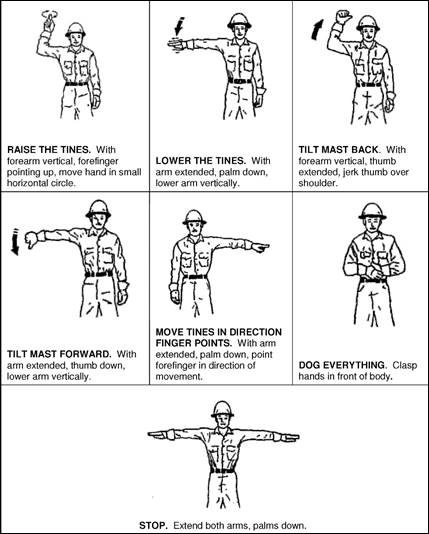
guides and signalers as necessary. If in doubt, check the conditions personally
before proceeding. Standard hand signals are shown in Figure 10.5, “Hand
Signals.”
t.
Do
not block fire extinguishers, fire protection sprinklers, or alarm stations
when stacking loads.
10.5.2 Intentionally omitted for Jefferson Lab
10.5.3 STANDARD
HAND SIGNALS
a. Standard hand
signals for use at DOE locations shall be as specified in the latest edition of
the ANSI standards for the particular forklift being used (see Figure 10-5).
b. The operator shall
recognize signals only from the designated signaler. However Obey a STOP signal
no matter who gives it.
c. For operations not
covered by standard hand signals, special signals shall be agreed on in advance
by both the operator and the signal person, and should not conflict with the
standard signals.
4.4
Rigging Loads from the Tines of a Forklift
(attaching rigging
to the forks to support a suspended load)
·
Prepare a Material Handling Lift Plan for
lifting and positioning suspended loads using a forklift, reference ES&H Manual Chapter
6141 Appendix T4 Hoisting and Rigging Operations (Including Planning a Lift)
·
Forklift
attachment booms and beam hooks are the preferred method of suspending a
load under forklift tines. Use of rigging gear attached directly to tines for
the suspension of a load is permissible under the following conditions:
o The rigging must be
approved gear that complies with the requirements of American Society
of Mechanical Engineers (ASME) B31.9 Slings and ASME B30.26 Rigging
Hardware: Safety Standard for Cableways, Cranes, Derricks, Hoists, Hooks,
Jacks, and Slings.
o Synthetic web slings
and round slings may be used in contact with the steel fork tines with adequate
protection from the corners of the tines.
o Slings are positioned
at a rated load center of the forklift and the load is equally distributed
between the two tines in a generally vertical configuration.
|
Alloy chain slings,
wire rope slings, shackles or other metallic rigging gear may not be used in
contact with fork tines.
|
·
A work control
document is used when planning to rig loads from the tines of a forklift that cannot be accomplished
with the above restrictions. A work control document is generated using
an approved electronic document control system for the facility requiring the
lift. A work planning tool such as the Accelerator Task List (ATLis) or similar
system is an acceptable work control document. In the work control document the
Material
Handling Manager is listed for notification and sign off.
·
A lift is designated critical if, when mishandled or dropped, any
of the following consequences could occur to the load, nearby installations, or
facilities:
o The load item, if
damaged or upset would result in a release into the environment of radioactive
or hazardous
material exceeding the established permissible environmental limits.
o The load item is
unique, if damaged it would be irreplaceable or not repairable; and it is vital
to a system, facility, or project operation.
o The cost to replace or
repair the load item, or the delay in operations would have a negative impact
on facility, organizational, or DOE budgets to the extent that it would affect
program commitments.
·
A Lift Plan is used for critical lifts as
determined by the appointed person planning the lift based on the criteria
above.
·
The MHM or designee reviews and observes all
critical lifts.

·
Keep all body parts inside the frame of the vehicle.
·
Use extreme caution when turning.
·
Use Extreme caution when moving a wide load.
·
Be aware of load height and overhead obstacles.
|
Accelerator Tunnel Inclines – where a tunnel incline is accessible to a forklift a work control document must be executed for
safe operation. Contact the MHM for
guidance and document sign off.
|
|
To prevent radiation exposure forklifts are not to remain in the
beam enclosure or Experimental Halls during beam operation.
|
5.0
References
·
ANSI/ITSDF
B56.1 Safety Standard for Low Lift and High Lift Trucks
6.0
Revision Summary
Revision 1.5 – 04/23/21 – Updated header and footer only, minor edits
no approval needed
Revision 1.4 – 01/24/18 – Updated TPOC from B.Sperlazza to M.Loewus
Revision 1.3 –
02/09/17 – Updated TPOC from D.Kausch to B.Sperlazza per B.Sperlazza
Revision 1.2 –
12/17/15 – Eliminated two positions previously identified as the MHSR and
the MHER, the responsibilities of these positions are now performed by the MHM.
Added the requirement to use a Material Handling Lift Plan in paragraph 4.4
Revision 1.1 –
06/03/15 – Periodic Review; Updated link for DOE Standard 1090
Revision 1.0 – 04/12/10 – Updated to
reflect current laboratory operations.