|
|
TITLE: |
||
|
|
|||
|
DOCUMENT ID: |
6147
Material Handling Equipment – Aerial
Work Platforms |
||
|
|
|||

1.0
Purpose
Aerial work platforms are mechanical devices used to lift workers and/or material (in a basket or bucket) into the air. Although technically not considered material handling equipment, at Jefferson Lab they are subject to the same requirements outlined within ES&H Manual Chapter 6140 Material Handling Equipment Program and its associated appendices. This document defines the additional requirements related to aerial work platforms.
This program complies with applicable federal, state, and local requirements as outlined in ES&H Manual 2410 Appendix T1 Hazard Issues List.
2.0
Scope
This chapter applies to the operation of aerial work platforms used on behalf of Jefferson Lab.
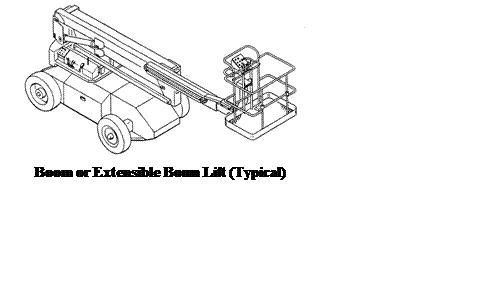
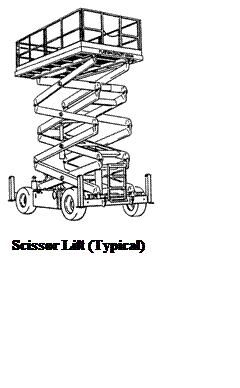
Table 1: Required Material Handling Training by Job Classification
|
Training Course |
Qualified Aerial Work Platform Operator |
|
Aerial Work Platforms SAF302 |
X |
|
Medical
Monitoring for Hazardous Work MED01 |
X* |
|
* Per ES&H Manual Chapter 6800 Appendix
T1 Medical Monitoring |
|
3.0
Responsibilities
NOTE: Management authority may be delegated to a task qualified
Jefferson Lab employee at the discretion of the responsible manager.
3.1 Qualified Aerial Work Platform Operator
· Possess a valid state motor vehicle driver’s license and carry it while operating an aerial work platform.
· Maintain current training (SAF302 Aerial Work Platforms) and Medical Monitoring for Hazardous Work (MED01). Refer to ES&H Manual Chapter 6800 Appendix T1 Medical Monitoring.
· Operate only those aerial work platforms for which they are authorized by the Material Handling Manager and the Work Area Coordinator.
· Utilize PPE (ES&H Manual Chapter 6620 Personal Protective Equipment (PPE) Program) and fall protection in accordance with Jefferson Lab requirements (ES&H Manual Chapter 6131 Fall Protection Systems).
3.1.1 Jefferson Lab’s Qualified Work Platform Operators (Employees) also:
· Report aerial work platform damage or malfunction to the Material Handling Manager.
· When using an aerial work platform at another facility to conduct Jefferson Lab business:
o Review the facility’s aerial work platform policies and procedures.
o Follow the more stringent safety procedures.
3.2 Material Handling Manager (MHM)
· Provide oversight of operator training.
· Maintain the aerial work platform program.
· Conduct aerial work platform operator training.
· Issue appropriate fall protection for equipment.
· Authorize employees and subcontractors access to specific aerial work platforms.
· Inspect subcontractor-provided aerial work platform equipment to ensure that minimum industry safety standards are met.
3.3 Supervisor/Subcontracting Officer’s Technical Representative (SOTR)/Work Area Coordinator
· Authorize only Qualified Aerial Work Platform Operators to operate aerial work platforms.
· Ensure appropriate PPE and fall protection is available for operations.
· Ensure the aerial work platform is inspected and maintained in accordance with the manufacturer’s instructions.
3.3.1 SOTRs also:
· Inform subcontractors that aerial work platforms are to be inspected by the MHM upon arrival at Jefferson Lab.
· Notify the MHM when a subcontractor is scheduled to bring aerial work platforms on site and coordinate inspections.
· Inform subcontractor that operators’ training and qualification requirements are required for review prior to commencement of work in accordance with ES&H Manual Chapter 6140 Material Handling Equipment Program.
· Submit a request to the MHM for subcontractors to attend special subcontractor aerial work platform operator safety orientation training (SAF302 Aerial Work Platforms) if required.
· Monitor subcontractor employees’ performance while using aerial work platform and notify the MHM of any concerns.
4.0
Expectations
Qualified aerial work platform operators at Jefferson Lab are approved by their Supervisor/ SOTR/Sponsor; trained on the proper use and operation of the equipment; and authorized access by the MHM. ES&H Manual Chapter 6147 Appendix T1 Training Requirements – Aerial Work Platforms provides the requirements necessary to be considered a Qualified Aerial Work Platform Operator at Jefferson Lab.
Procurement of aerial work platforms follow the minimum procedure provided in ES&H Manual Chapter 6140 Appendix T2 Procurement of Material Handling Equipment. Jefferson Lab requires that procurement of aerial work platforms adhere to the additional requirements outlined in ES&H Manual Chapter 6147 Appendix T2 Procurement Requirements – Aerial Work Platforms.
ES&H Manual Chapter 6147 Appendix T3 Use of Aerial Work Platforms defines the requirements for safe operation of aerial work platforms used on behalf of Jefferson Lab.
5.0
References
29 CFR 1910.333 (c)(3) Working on or near exposed energized parts – Overhead Lines
ANSI A92.3 Manually Propelled Elevating Work Platforms
ANSI A92.5 Boom Supported Elevating Work Platforms
ANSI A92.6 Self-Propelled Elevating Work Platforms (Scissor Lifts)
ANSI/NFPA No. 30 Storage and Handling of Liquid Fuels, such as Gasoline and Diesel Fuel
ANSI/NFPA No. 58 Storage and Handling of Liquefied Petroleum Gas
U.S. Army Corps of Engineers Safety Manual
Manufacturers’ Operating and Safety Manuals
6.0
Revision Summary
Revision 1.5 – 07/14/2020 – Periodic Review; Updated the division to
ES&H, updated the header to cjohnson, update reference link ES&H manual
chapter 6140 and updated review date to 7/14/2023.
Revision 1.4 – 08/18/17 – Updated TPOC from B.Sperlazza to M.Loewus; added new
reference ANSI-A92.6 Self-Propelled Elevating Work Platforms
Revision 1.3 – 02/09/17 – Updated TPOC from D.Kausch to
B.Sperlazza per B.Sperlazza
Revision 1.2 – 12/18/15 – Periodic Review; eliminated two positions previously identified as the MHSR and the MHER, the responsibilities of these positions are now performed by the MHM.
Revision 1.1 – 05/20/14 – Added Required Safety Training Table
Revision 1.0 – 09/15/10 – Updated to reflect current laboratory operations




|
|
ISSUING
AUTHORITY |
TECHNICAL POINT-OF-CONTACT |
APPROVAL
DATE |
REVIEWDATE |
REV. |
|
|
|
ES&H Division |
08/18/17 |
07/14/23 |
1.5 |
|