|
|
TITLE: |
||
|
|
|||
|
DOCUMENT ID: |
6540
Appendix T3 ODH Emergency Response Procedure |
||
|
|
|||

Jefferson Lab recognizes
that the physical and mental condition of individuals exposed to an oxygen deficient environment rapidly deteriorates and requires immediate action. This appendix outlines the procedure for responding to an oxygen
deficiency event and/or an oxygen deficiency hazard (ODH) alarm.
The ODH Emergency Response Procedure outlined in this appendix
applies to individuals who are not trained or qualified to perform emergency
response activities. Only individuals, trained in emergency response, have priority
access to buildings and are authorized to respond according to their
training.
This appendix is written in
coordination with ES&H
Manual Chapter 6540 Oxygen Deficiency Hazard Control Program. All relevant
content within the chapter applies to the procedure outlined in this appendix.
|
NOTE: Emergencies
related to cryogens
are discussed in ES&H
Manual Chapter 6550 Appendix T2 Emergency Response to Cryogens. Emergency
response for other situations is discussed in ES&H Manual Chapter
3510 Emergency Response Activities. |
NOTE: Management
authority may be delegated to a task qualified Jefferson Lab employee at the
discretion of the responsible manager.
·
Perform the process steps in response to an ODH event
and/or alarm.
3.2
Supervisor, Technical Representative (SOTR), Sponsor
·
Determine
appropriate muster points and inform individuals under your authority in
accordance with the requirements of ES&H Manual Chapter 3510
Emergency Response Activities. See area evacuation maps for locations of
muster points.
·
Report
any near-miss or actual ODH events to the ESH&Q Reporting
Officer in accordance with ES&H Manual Chapter 5200
Event Investigation and Causal Analysis Process.
Detection of Oxygen Deficiency
– A potential
oxygen deficiency is indicated when one or more of the following activates or
is present:
·
A
flashing ODH (blue) warning light
·
An
ODH horn sounds
·
A
loud warning tone, alarm vibration, or flashing light from a personal oxygen
monitoring device
·
You
or someone in your vicinity shows signs of exposure symptoms (see note below)
·
Visible
vapor plume
·
Rushing
gas sound
|
NOTE: EXPOSURE
SYMPTOMS Personal symptoms include: dizziness, unexplained loss of
coordination, increased heart rate. If any of these symptoms occur, seek fresh air and medical attention
immediately even if the ODH
alarm does not activate. |
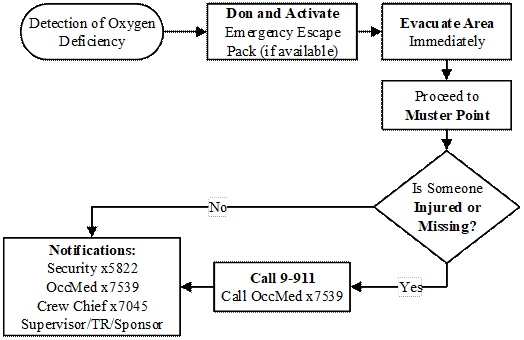
Step 1: Don and Activate an Emergency Escape
Pack (EEP) if available.
Step
2: Evacuate the area.
(If outdoors, evacuate 100 meters upwind from a plume. If indoors, evacuate out
of the building and remain upwind.)
·
Stay
away from vapor plumes.
o
If
you see a vapor plume, use an alternate route.
o
If
you find yourself in a vapor plume and do not have an EEP, hold your breath
until you are clear.
·
If
a worker is injured or unconscious, do
not attempt to rescue them.
Step
3: Muster Point
·
Assemble
at designated muster point identified by your Supervisor.
·
Call 911 and Occupational Medicine
(x7539)
immediately if:
o Workers are missing or injured.
o
You
are unsure of a person’s location or condition.
Step
4: Notify (from a safe location)
·
Security (x 5822) immediately,
·
Occupational
Medicine (x 7539),
·
Crew
Chief (x 7045), and
·
Supervisor/TR/Sponsor/
Figure 1:
Flowchart for ODH Emergency Procedure
5.0
Revision Summary
Revision
1.5 – 11/06/2020 – Periodic Review; updated
header and footer, changed SOTR to TR, updated the flowchart, minor updates no new
approval needed.
Revision 1.4 – 11/06/17 – Periodic
Review; deleted
Non-Emergency Situation note as material is covered in T2, incorporated footnotes
into text.
Revision 1.3 – 06/30/16 – Clarified Emergency Response
Expectations
Revision 1.2 – 06/22/16 – Updated TPOC from D.Owen to
J.Williams; added an additional
detection method; clarified outdoor evacuation distance
Revision 1.1 – 06/27/13
– Added verbiage
to clarify scope
Revision 1.0 – 01/17/12
– Updated to
reflect current laboratory operations


|
|
ISSUING AUTHORITY |
TECHNICAL POINT-OF-CONTACT |
APPROVAL DATE |
REVIEW DATE |
REV. |
|
|
|
ES&H Division |
11/06/17 |
11/06/23 |
1.5 |
|
This document is
controlled as an on line file. It may be
printed but the print copy is not a controlled document. It is the user’s responsibility to ensure
that the document is the same revision as the current on line file. This copy was printed on 12/1/2020.