|
|
TITLE: |
||
|
|
|||
|
DOCUMENT ID: |
6630 Appendix T1 Engineering Controls – Fixed and Portable Exhaust Ventilation |
||
|
|
|||

1.0
Purpose
Whenever
respiratory hazards cannot feasibly be mitigated through material substitution,
engineering
controls (in the form of fixed and/or portable exhaust ventilation) are the
preferred methods. This appendix provides how to determine if engineering
controls are required; appropriate use parameters; and repair, maintenance, and
inspection schedules.
2.0
Scope
This appendix covers fixed and
portable exhaust ventilation available at Jefferson Lab. Table 1 provides the
minimum capture velocities required to mitigate a hazard for a typical
condition. These are representative conditions found at Jefferson Lab, other
conditions may apply. Contact Industrial Hygiene if there is concern regarding
your specific condition.
Table
1 - Fixed and Portable Exhaust
|
Contaminant Velocity |
Minimum Capture Velocity (feet per minute) |
|
|
Vapors from degreasing, or soldering |
No significant velocity |
50–100 |
|
Spray
paint booths, welding, solvent, and acid work |
Low initial velocity |
100–200 |
|
Spray
painting into shallow booths, container filling, and crushing |
Significant velocity |
200–500 |
|
Grinding,
and abrasive-blasting |
High velocity |
500–2000 |
This appendix is written in
coordination with ES&H
Manual Chapter 6630 Respiratory Protection Program. All applicable content
within the chapter applies to the process steps outlined in this appendix.
3.0
Responsibilities
NOTE: Management authority may be delegated to a task qualified Jefferson Lab employee at the discretion of the responsible manager.
3.1 Anyone at Jefferson Lab
·
Request
an equipment/area hazard evaluation from Industrial Hygiene if you have
concerns regarding air quality.
· Use exhaust ventilation in accordance with intended condition.
· Submit a Facilities Management Work Request when equipment is not performing up to standards.
3.2
Facilities
Management
· Repair exhaust ventilation as requested and maintain per manufacturer’s recommendations.
· Contact Industrial Hygiene when repair/maintenance activities have been performed.
· Recommend appropriate mitigation (including material substitution) for respiratory hazards in accordance with findings from the hazard evaluation.
· Perform and record exhaust ventilation inspections.
4.0
Process Steps
Figure 1 - Exhaust Ventilation Determination Process
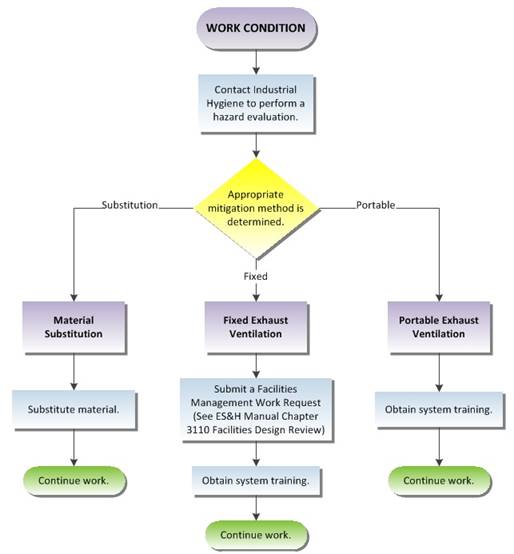
4.1 Determining Need
In accordance with your Task Hazard Analysis, request a hazard evaluation for the work condition. When mitigation method is determined, follow the applicable instructions detailed in Table 2.
Table
2 - Instructions per Mitigation
Method
|
IF |
THEN |
|
Material
Substitution |
Substitute material, and continue work. |
|
Fixed Exhaust Ventilation Required* (e.g., chemical fume hood, capture hood, stud hood) |
Submit a Facilities
Management Work Request. |
|
Portable Exhaust Ventilation Required (e.g., smoke eaters, HEPA vacuums) |
Obtain system training, and continue work. |
|
*All fixed exhaust units are installed by Facilities
Management. |
|
4.2
Use
of Fixed Exhaust Ventilation
4.2.1
Prior
to use:
· Read and abide by the manufacturer’s instructions.
· Ensure airflow is adequate for the condition.
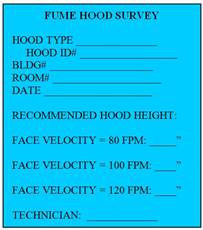
· Read the Inspection Label (Figure 2):
o Ensure inspection is valid within one year of previous inspection. Contact Industrial Hygiene if out of date.
o Set work up to abide by:
§ appropriate sash height
§ working capture distances
Figure
2 - Example Fume Hood Inspection
Label
|
Chemical Fume Hood Inspection Label |
4.2.2
During
use:
Abide by the following controls outlined in Table 3.
Table
3 – Fixed Exhaust Ventilation Controls
|
Parameter |
Control |
|
Face Velocity |
·
Maintain appropriate sash height or working
capture distances. ·
Maintain the hood sash at
the smallest practicable open area. ·
Use the sash as a protective shield. |
|
Cross Drafts |
Position material to
minimize cross drafts. |
|
Turbulence and/or Dead Spots |
Minimize by: ·
Regulating face velocity ·
Placing items at least
6-inches from the opening. ·
Raising bulky objects off the work surface.
|
|
Capture Velocity |
100% capture is required. |
|
Storage |
Hoods are not to be used
for: ·
Routine storage or ·
Evaporation of spent chemicals. |
|
Body Positioning |
Keep head and body out of the pathway between contaminant/condition
and capture. Never place your head inside a fume hood when chemicals are in use! |
|
Personal Protective Equipment |
Dependent on condition.
See ES&H Manual
Chapter 6620 Personal Protective Equipment Program for more information. |
|
NOTE: If at any time your exhaust ventilation
is not functioning adequately: · Discontinue use.
· Submit a
Facilities Management Work Request for repair or maintenance. · After repairs
have been made, contact Industrial Hygiene to ensure adequate air flow. |
4.2.3
Inspection:
Industrial Hygiene
performs the following inspections on exhaust ventilation:
·
Before initial
start-up
·
Annually thereafter
·
After any adjustment,
modification, or maintenance
Requirements
based on inspection results are outlined in Table 4 below:
Table
4 – Fixed Exhaust Inspection
Findings
|
If the
Hood |
Then |
|
Passes inspection |
·
An appropriate hood inspection label is provided. |
|
Does not pass inspection |
·
The hood is placed out of service. ·
A Facilities Management Work Request is submitted. ·
Another inspection is scheduled after repair of
unit. |
4.3
Use
of Portable Exhaust Ventilation (HEPA
Vacuum/Smoke Eater):
4.3.1
Prior to use:
·
Obtain HEPA
vacuum/smoke eater from IH.
·
Select HEPA
vacuum/smoke eater appropriate for task (seek assistance from IH for selection)
o Lead vacuums
o Particulate vacuum (general dusts & silica)
o Smoke eaters (selection based on type of
welding/grinding)
·
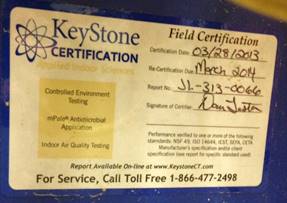
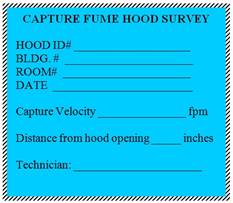
Read the
Inspection Label (Figure 3):
o Ensure inspection is valid within one year of previous
inspection. Contact Industrial Hygiene if out of date.
o Set work up to abide by:
§ working capture distances
Figure
3 - Example HEPA Vacuum / Smoke Eater Inspection Labels
|
HEPA
Vacuum Certification Label |
|
Inspection
Label on Smoke Eater |
4.3.2
During use (HEPA vacuums):
·
Operate vacuum
directly onto surface cleaning or point of dust capture.
·
Do not open
collection bag or HEPA filter (return to IH for maintenance).
·
If dropped do not
use; return unit to IH.
·
Store HEPA vacuum
parts (power cord, hoses, etc.) as appropriate for vacuum.
·
Return HEPA
vacuum to IH when work is complete.
·
NOTE: IH HEPA
vacuum must not be used in Radiologically Controlled Areas. Contact RADCON for
assistance if HEPA vacuum is needed in a Radiologically Controlled Area.
4.3.3
During use (smoke eaters):
Abide by the following controls outlined in Table 5.
Table
5 - Portable Exhaust Ventilation Controls
|
Parameter |
Control |
|
Face Velocity |
Maintain appropriate working capture distances. |
|
Cross
Drafts |
Position
material to minimize cross drafts. |
|
Turbulence
and/or Dead Spots |
Minimize
by: · Regulating face
velocity. · Raising bulky
objects off the work surface. |
|
Capture
Velocity |
100% capture
is required. |
|
Body
Positioning |
Keep
head and body out of the pathway between contaminant/condition and capture. |
|
Personal
Protective Equipment |
Dependent
on condition. See ES&H Manual Chapter
6620 Personal Protective Equipment Program for more information. |
5.0
Reference(s):
·
Industrial Ventilation, A Manual of
Recommended Practice – 26th edition
6.0
Revision
Summary
Revision
1.3 – 02/21/20 – Periodic Review; minor
edits to Section 4.3.2 per CATS# STR-2019-10-06
Periodic Review – 06/08/18
– No changes per
TPOC
Periodic Review – 06/08/17
– No changes per
TPOC
Periodic Review – 04/11/16
– No changes per
TPOC
Revision
1.2 – 04/08/15 – Periodic Review; minor
edits with no substantive changes
Revision 1.1 – 09/04/13
– Periodic Review; Changed
title to reflect content; updated flowchart; added examples to mitigation
methods; added new process steps for HEPA vacuums/smoke eaters per J.Williams
Revision 1.0 – 08/11/11 – Updated to reflect current
laboratory operations.


|
|
ISSUING
AUTHORITY |
TECHNICAL
POINT-OF-CONTACT |
APPROVAL
DATE |
REVIEW DATE (Annual Review Required) |
REV. |
|
|
|
ES&H Division |
02/21/20 |
02/21/21 |
1.3 |
|