 decay width comes from measurement of the photon flux. This is quoted
in the error budget1
of the proposal as 1%. This document outlines a TDC sampling method
for measuring the flux and estimates the associated errors.
decay width comes from measurement of the photon flux. This is quoted
in the error budget1
of the proposal as 1%. This document outlines a TDC sampling method
for measuring the flux and estimates the associated errors.
Photon Flux Measurement for PrimEx Using TDC Sampling
February 10, 2003
D. Lawrence, University of Massachusetts
Table of Contents
Introduction 2
Measuring Photon Flux Using Scalers 2
Initial Rate Calculation 3
Extracting Rates from TDCs 3
Trigger Supervisor Scalers 5
Total Detector Hits During Livetime 6
Corrections 6
LIFO Correction 7
TDC Deadtime Correction 8
Detector Efficiency 9
10
Error Estimates 10
Error Due to LIFO Correction 10
Error Due to TDC Deadtime Correction 12
Error Due to Beam Current Oscillation 13
Error Due to Beam Current Drift 14
Summary 15
Derivation of equation 4. 17
Introduction
The main contribution to the
error bar in the PrimEx measurement of the
decay width comes from measurement of the photon flux. This is quoted
in the error budget1
of the proposal as 1%. This document outlines a TDC sampling method
for measuring the flux and estimates the associated errors.
The photon flux referred to here is a measurement of the number of tagged photons incident on the physics target. For most experiments, including PrimEx, these photons are produced at a rate far greater than is practical for measuring all of them directly through a data acquisition system(DAQ). It would be possible, however, to measure them all via hardware scalers (excluding a small fraction lost due to deadtime). See the following section for a discussion on how using scalers compares to the TDC sampling method.
The photon flux can be calculated by sampling the number of tagged photons for a small fraction of the time and estimating the rate at which tagged photons occur. This can then be used to extrapolate to all time in order to determine the total number of tagged photons represented by a given data sample.
There are some limitations of this method due to limitations in the DAQ system itself. These limitations are known and can be corrected for. The corrections themselves, however, introduce additional errors which can be non-trivial.
Measuring Photon Flux Using Scalers
A more traditional method used to measure normalization is to count the number of hits in a particular detector using scalers. Scalers have the advantage of being able to count virtually2 all hits from a detector. The counts can be corrected for the livetime using the ratio of a gated scaler to a free running scaler. Providing these scalers count signals from a beam related source, this method automatically accounts for beam trips as well.
The problem with using scalers basically boils down to this: To calculate the cross section, we need to know the fraction of tagged photons which produced a pi0 at a particular energy and angle. The key point being that “tagged photons” in the numerator must be identified using the same criteria as those in the denominator. If we discard events in the numerator in which a photon cannot be fully reconstructed3, we must discard the same type of events in the flux calculation. The only way to guarantee that this is the case is to apply the same software cuts to the “normalization” photons as are being applied to the “signal” ones.
Initial Rate Calculation
Extracting Rates from TDCs
The rate at which a detector fires can be determined via TDC information. The TDC's currently installed in the photon tagger are LRS1877 types. These are multi-hit TDCs with the capability of storing up to 16 hits per channel with a maximum range of 32 usec4. The idea is simply to count the number of hits in a particular channel and divde by the size of the time window. The initial or raw rate can be calculated from equation 1. Several correction factors (described in the following sections) will need to be applied in order to obtain the rate the detector actually fired at. Since even high rate detectors will tend to have only a few hits per event on average, it is necessary to integrate over many events to obtain an accurate value for the rate.
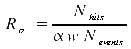 (1)
(1)
where:



Figure 2 shows an example of a raw TDC spectrum for a single T-counter in the tagger. This data is from a high intensity run (100 nA) during the PrimEx beam test in August 2002. One obvious effect is how the number of hits trail off to the right side of the spectrum due to the LIFO limit. Since the LRS1877 is used as a common stop TDC, earlier times are to the right and later times to the left in this plot. The LRS1877 will always report the latest hits. Thus, when the LIFO fills up, the earlier hits are overwritten by the later ones. Correcting for this effect is discussed later in the section on LIFO correction.
An important thing to keep in mind when counting hits is to discard hits that could be associated with the trigger. Hits which are correlated with the trigger are biased and will artificially increase the calculated rate. An “Out-Of-Time” window (OOT) should be defined which can include areas both before and after the trigger peak(s)5. Additionally, events which contain a hit in the trigger area of the TDC spectrum or before the lower edge of the OOT should be discarded from the rate calculation. This is because these hits each use one buffer in the LIFO which would mean the LIFO correction should be based on a smaller LIFO size for these events than for others.
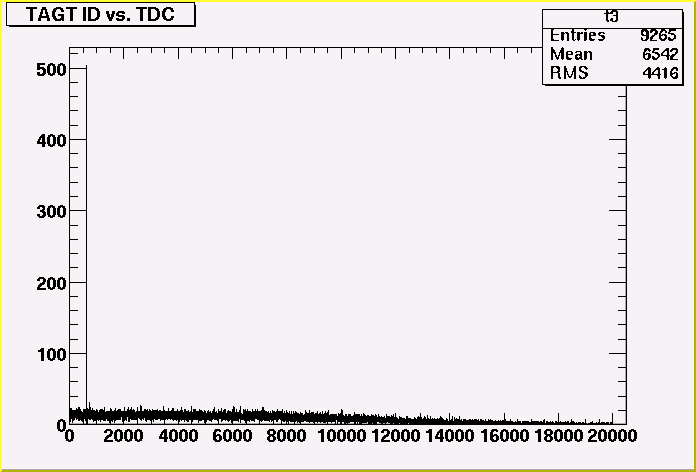
Figure
1 TDC spectrum for T-counter 3. Units are in TDC counts. The spike
near TDC=600 is due to hits correlated with the trigger. The
drop-off at larger TDC values (earlier times) is due to the LIFO
limit.
Trigger Supervisor Scalers
PrimEx will use a second generation of the Jlab designed Trigger Supervisor module (TS). This is a VXI module desgined specifically to optimize events rates for Fastbus and VME based DAQ systems like those commonly used in medium and high energy physics experiments. One new feature in the second generation model is the inclusion of two scalers dedicated to measuring the livetime. Both scalers are driven by a 200kHz internal clock. One, however, is livetime gated while the other is free running. The ratio of the two will give the livetime. One consequence of their being driven by a clock rather than a beam related device is that beam trips must be excluded through a software mechanism during replay. Determining trips is outside the scope of this document so it is assumed they have been effectively removed for the purposes of this discussion.
Ultimately, one is really only interested in the final number of hits a detector saw during the livetime of the data sample. This can be obtained using only the live-time-gated scaler to calculate the actual livetime as is shown in Equation 2. Note that the free running scaler is not needed.
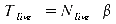 (2)
(2)
where:

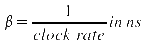
It is neccesary that the clock be very very stable with a constant frequency. The absolute frequency itself is not important as will be shown in the next section.
Total Detector Hits During Livetime
The total number of hits a detector sees during the livetime of the data sample is given by Equation 3.
 (3)
(3)
All terms in Equation 3 are
simply counted with the exception of the ratio .
This ratio represents the factor for converting the TS's internal
clock period into TDC counts. This ratio can be determined from
specifications for the hardware involved. It can also be explicitly
measured using a trival setup with an external pulser. The error on
the ratio will be negligibly small. In
fact, only
.
This ratio represents the factor for converting the TS's internal
clock period into TDC counts. This ratio can be determined from
specifications for the hardware involved. It can also be explicitly
measured using a trival setup with an external pulser. The error on
the ratio will be negligibly small. In
fact, only will
contribute any significant error to
will
contribute any significant error to .
.
Corrections
The number of hits seen by the mutli-hit TDCs for a given channel will be systematically undermeasured due to multiple conditions existing in the DAQ system and detectors themselves. This section describes those conditions and how the rates measured via Equation 1 can be corrected. The TDC related corrections are based on the rate at which a detector fires. Since the total number of hits scales with the rate, the correction factors derived for the rates can also be applied directly to the number of hits.
LIFO Correction
The LRS1877 Fastbus TDC has a programmable LIFO of up to 16 hits per event per channel. If a channel gets more hits in a single event than the LIFO can hold, the oldest hits are replaced with the newest ones. This means that the number of hits in a given channel will be systematically undercounted due to the LIFO limit. This effect can be reduced by setting the size of the TDC window small and the LIFO size big. However, there is a trade-off in that more events will be required to reduce the statistical error. This also means integrating over a long period of time which can increase the systematic error due to beam drift (see the section on Beam Drift). Here, the correction required for missed hits due to LIFO size is calculated as a function of rate. Figure 2 shows the correction generated from a Monte Carlo calculation. The correction is plotted versus the product of detector rate and OOT size over LIFO size. The X-axis can be thought of as the average fraction of LIFO buffers filled per event. The curve in this plot comes from a 4th order polynomial fit to the points. The Monte Carlo will need to be run again with more statistics and more points to better define the curve.
The beam current presented in
the proposal of equivalent
photons per second corresponds to a T-counter rate of 1MHz per
T-counter. The T-counters will be firing at higher rates than any
other detector in the PrimEx experiment and so, will require the
largest corrections.
equivalent
photons per second corresponds to a T-counter rate of 1MHz per
T-counter. The T-counters will be firing at higher rates than any
other detector in the PrimEx experiment and so, will require the
largest corrections.
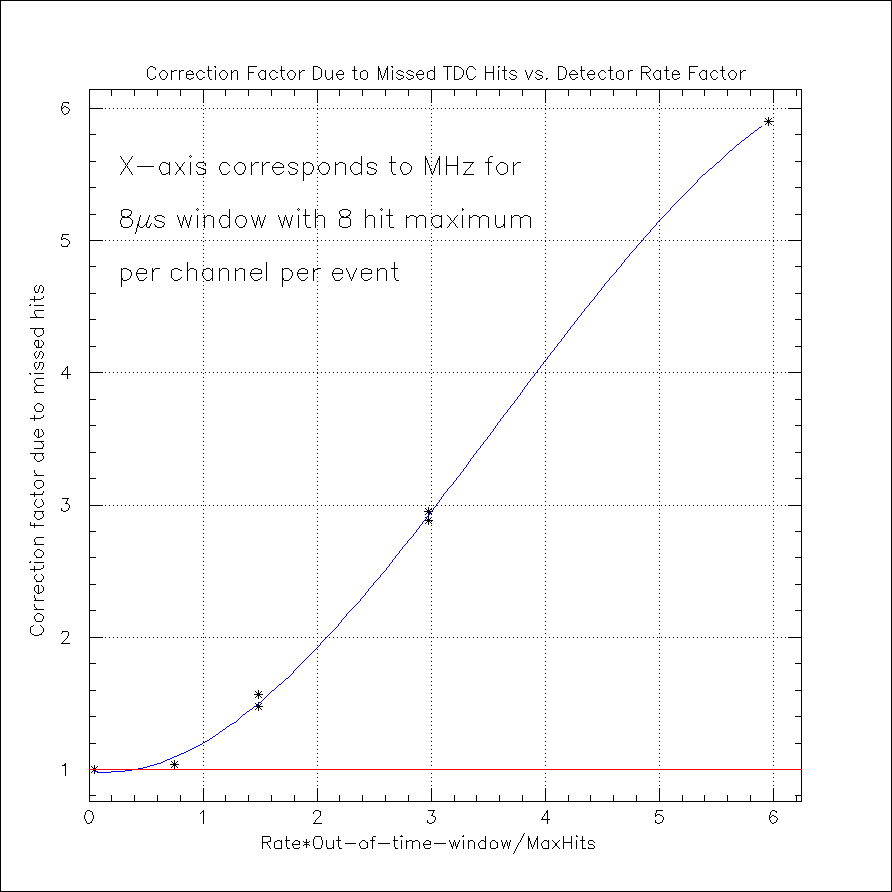
Figure
2 Multiplicative correction factor to account for hits missed due to
the LIFO limit from Monte Carlo calculation. The x-axis can be
thought of as the average fraction of the LIFO buffers filled per
event. For the August 2002 beam test, a LIFO of 8 was used with a
maximum TDC window of 10 usec.
TDC Deadtime Correction
The LRS1877 TDC module has a deadtime associated with each hit. Hits that occur too close in time with the previous hit will be missed and the rate will be, again, undercounted. For low rate detectors, this effect is negligible. For detectors firing at 1 MHz, however, this can be significant for a precision experiment such as PrimEx.
The time between adjacent
hits in a detector firing at a given rate from unrelated events is
governed by an exponential probability function. The measured rate
will be proportional to the probability that the detector does NOT
fire during the deadtime .
To obtain the actual rate, this must be divided out as shown in
Equation 4.
.
To obtain the actual rate, this must be divided out as shown in
Equation 4.
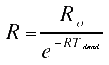 (4)
(4)
Equation 4 can be solved
for in
terms of
in
terms of andby
expanding the exponential and keeping only the first few terms.
Expanding to just two terms results in Equation 5.
andby
expanding the exponential and keeping only the first few terms.
Expanding to just two terms results in Equation 5.
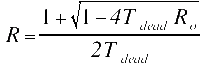 (5)
(5)
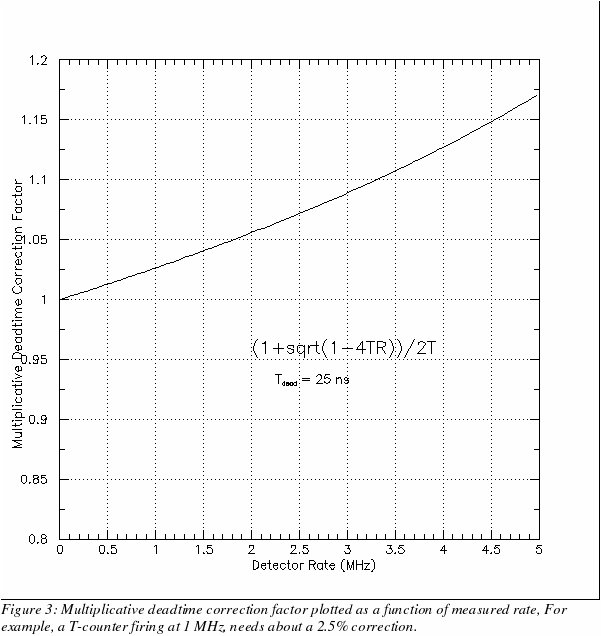
Figure 3 shows a plot of the deadtime correction factor given by Equation 5.
Detector Efficiency
The detector efficiency of the tagger should not affect the final cross-section. This is due to the efficiency appearing in both the numerator and denominator of the cross-section calculation such that it cancels out. This does not neccesarily include inefficiencies which can be introduced through the reconstruction software itself. For example, pi0 events will always occur at later times (close to the beginning of the TDC spectrum) while normalization events will come from the entire TDC spectrum. Should an inefficiency develop for events reconstructed at earlier times due to LIFO limits, this could effect the normalization calculated. Correcting for software coincidence inefficiencies due to hardware limits requires a significant extension to the details presented here and so will be covered by a separate note.
Error Estimates
Error Due to LIFO Correction
Application of a correction
factor to a rate will itself induce an additional error in the
measurement. The LIFO correction factor is a function of the raw,
measured rate.
The error oncan
be propagated through the correction formula to determine this error
as a function of the adjusted rate parameter plotted on the X-axis.
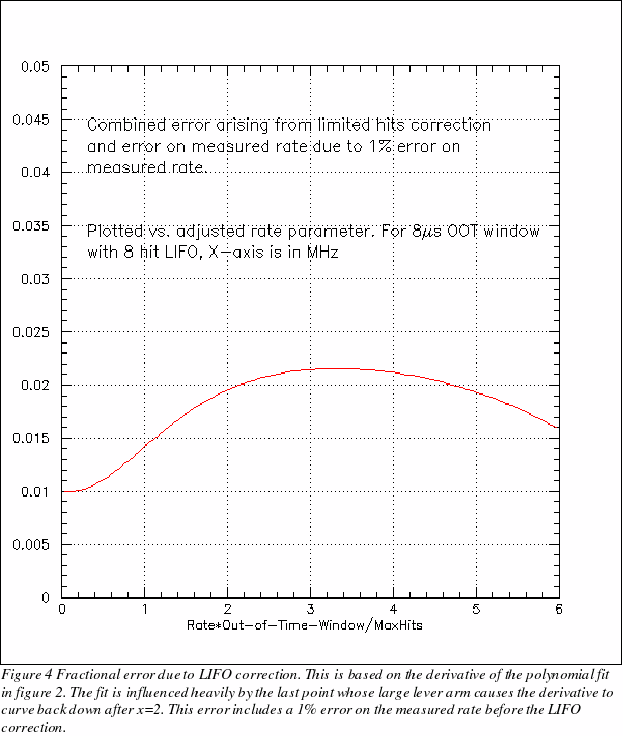
This has been done and the result is shown in figure 4. One would not
expect the curve to bend back over as it does and this likely due to
a limitation on how the Monte Carlo was performed. The curve is
believed to be accurate up to to X=2 however.
It is important to note that
the error due to the LIFO correction will be perfectly correlated
with the error onitself.
Since these errors will always have the same sign, they must
be added linearly as opposed to adding them in quadrature. This
increases the error bar from what it would be for uncorrelated
errors.
Error Due to TDC Deadtime Correction
The TDC deadtime correction
(Equation 4) is dependent upon two input parameters:and.
These are independent, but both may contain errors which must be
propagated through to the final error bar. The partial derivatives of
Equation 4 with respect to each of these should be added in
quadrature to give the total error due to the TDC deadtime
correction. The relative error due to the error on
is
given by Equation 6 while that due to the error onis
given by equation 7.
 (6)
(6)
 (7)
(7)
Note in Equation 7 that the
relative error
 has
been explicitly subtracted out in order to obtain the error induced
by the correction factor alone. This is different than how the LIFO
error was presented above (i.e. as the combined error due toand
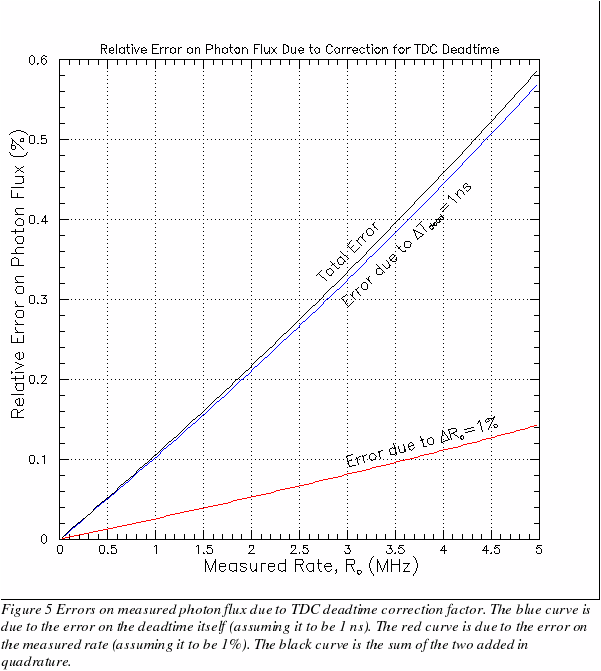
the LIFO correction factor). Figure 5 shows the individual and
combined contributions of these errors to the flux measurement. The
error on
is
assumed to be 1 ns. The error bar is directly proportional to this
value so if this can be measured at the 0.5 ns level, the total error
will be nearly half what is plotted.
has
been explicitly subtracted out in order to obtain the error induced
by the correction factor alone. This is different than how the LIFO
error was presented above (i.e. as the combined error due toand
the LIFO correction factor). Figure 5 shows the individual and
combined contributions of these errors to the flux measurement. The
error on
is
assumed to be 1 ns. The error bar is directly proportional to this
value so if this can be measured at the 0.5 ns level, the total error
will be nearly half what is plotted.
Error Due to Beam Current Oscillation
Use of a sampling technique
can lead to overcounting if the times at which the samples are taken
tend to be when the rates are higher. This effect can be calculated
if we assume a beam current of the form .
The frequency
.
The frequency is
assumed to be large enough that many oscillations occur over the
course of a run yet small enough so the rate is essentially constant
over the sampling time (typically around 10 usec).
is
assumed to be large enough that many oscillations occur over the
course of a run yet small enough so the rate is essentially constant
over the sampling time (typically around 10 usec).
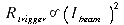
The PrimEx trigger is dominated by accidentals from Compton scattering in the window of the vacuum box and the helium inside the helium bag. This means the trigger rate will be proportional to the beam current squared:
Assuming hits in the tagger are dominated by good electrons, the tagger rates will increase linearly with the beam current:

The number of hits a detector sees over the course of the run will then be:

where is
the out of time window width and
is
the out of time window width and is
a proportionality constant.
is
a proportionality constant.
Integration yields:
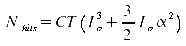
The first term gives the
number of hits which would be recorded for the case when .
The fractional increase in the number of hits recorded is then given
by:
.
The fractional increase in the number of hits recorded is then given
by:
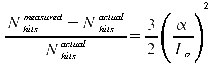
Take, for example, the case
when
 is
10% of
is
10% of .
The number of hits recorded will be increased by
.
The number of hits recorded will be increased by
 or
1.5%.
or
1.5%.
Error Due to Beam Current Drift
Occasionally, a very slow
drift can be observed in the beam current that becomes significant
over time. Assuming a beam current of the form ,
the above calculation can be repeated for an integration period of
,
the above calculation can be repeated for an integration period of to
to
 .
The resulting number of hits is:
.
The resulting number of hits is:

The fractional increase in the number of hits due to beam drift is then given by:
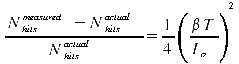
As an example, consider a
period for which the beam drifted down by 20% before it was
corrected. The number of recorded hits will be overcounted by
 or
1%. This can be controlled somewhat during the analysis by reducing
the time slices over which the counts are integrated. One might also
try and detect such drifts and either remove the affected data, or
correct for the effect.
or
1%. This can be controlled somewhat during the analysis by reducing
the time slices over which the counts are integrated. One might also
try and detect such drifts and either remove the affected data, or
correct for the effect.
Summary
The photon flux can be measured by sampling the rates of the tagger detectors. Two systematic corrections, however, must be considered when determining the rate via this sampling method. These are due to the TDC deadtime and the LIFO limit. The corrections themselves can be determined precisely given the hardware settings. They do, however, introduce additional components to the measurement error which have been calculated here.
The sampling technique is also susceptible to systematic overcounting due to beam instabilities. Errors due to beam instability cannot be corrected for (unless the nature of the instability is known precisely). It seems imperative that if this technique is used, the beam stability must be accurately measured and closely monitored.
The contributions to the total error on the photon flux measured using this technique is summarized in the following table.
|
Error Source |
Error |
Type |
|---|---|---|
|
Raw Rate/LIFO |
1.40% |
Statistical* |
|
Deadtime Correction (Rate) |
0.05% |
Statistical* |
|
Deadtime Correction (Deadtime) |
0.10% |
Systematic |
|
Beam Current ( |
0.40% |
Systematic |
|
Total |
~1.46% |
|
Important things to keep in mind:
 Tagging ratios may introduce
additional errors
Tagging ratios may introduce
additional errors
Errors propagated from the
error on the initial rate measurement will be correlated and so,
should be added linearly
The error on the initial rate
measurement was assumed to be 1% but it may be much less. It will be
statistical in nature and can therefore be reduced by including more
statistics.
Appendix A
Derivation of equation 4.
First, we'll derive the exponential probability function. This can be looked up in any of a number of textbooks. Reviewing it here, however, helps sharpen our understanding of these formalisms which we'll use to extend the calculation later.
The problem is to find the
probability that a detector firing at an average rate
will
fire at a time
 within
a period
within
a period
 .
Start by breaking up time into bins of size.
For small,
the probability that a hit will occur in a given bin is given by:
.
Start by breaking up time into bins of size.
For small,
the probability that a hit will occur in a given bin is given by:
 (A1)
(A1)
The probability that the
detector will not fire in the same time period is just
 .
We can now write the probability of the detector not firing in the
first N bins. It is just:
.
We can now write the probability of the detector not firing in the
first N bins. It is just:
 (A2)
(A2)
Solving A2 for ,
the differential of the probability can be written as:
,
the differential of the probability can be written as:
 (A3)
(A3)
Extrapolating to the
continuum,becomes
arbitraily small such that
 .
This leads to:
.
This leads to:
 (A4)
(A4)
Dividing by on
both sides and integrating gives the form of the probability
function:
on
both sides and integrating gives the form of the probability
function:
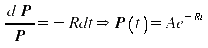 (A5)
(A5)
Imposing the limit that the
differential probability must integrate to 1 over all time6
reveals that
 .
This yields, finally, the probability that the detector does not
fire during a timeas:
.
This yields, finally, the probability that the detector does not
fire during a timeas:
 (A6)
(A6)
Thus, the probability of the
detector firing at least once during the same time is just
 .
This is actually just a simple form of Poisson's equation. According
to Poisson's equation, the probability of having
.
This is actually just a simple form of Poisson's equation. According
to Poisson's equation, the probability of having hits
from a detector firing at a rate
during a timeis:
hits
from a detector firing at a rate
during a timeis:
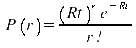 (A7)
(A7)
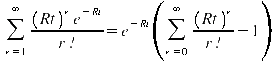
The probability of having zero hits is obtained by setting r=0 which returns equation A6. The probability of having one or more hits is:

1Primex Note 1, pg. 48
2The scaler will have a deadtime for each hit of at least the discriminator width. A second hit which occurs during this time will be missed.
3Timing and geometric coincidence.
4For the August 2003 beam test, we generally set the LIFO size to 8 hits and the range to 10 usec.
5Since we typically run with multiple triggers (some heavily prescaled), multiple peaks may show up in a detectors TDC spectrum. To make things simpler, it is desirable to use only events from a single trigger.
6Integration from 0 to infinity where 0 is chosen at some arbitrary point, but not at -infinity.
 %)
%)