As one of the results of the above described procedure the relative locations of had to be determined.
The location of 2C24A beam position monitor and  -Profiler were read off the design drawing 28405-E-0034
and related drawings.
The
-Profiler were read off the design drawing 28405-E-0034
and related drawings.
The  location of the crystal part of HyCal came from survey data. The coordinates of these beam line devices were
collected in a table below,
location of the crystal part of HyCal came from survey data. The coordinates of these beam line devices were
collected in a table below,
| device | x (cm) | y (cm) | z (cm) |
| -Profiler |
-0.8563 | 0.0322 | 980.30 |
| HyCAL | 0.0 | 0.0 | 731.89 |
| Target | -0.063 | 0.07 | 0.0 |
| HARP 2H00 | 0.0 | 0.012 | -65.73 |
| BPM 2C24A | 0.0 | 0.0 | -1049.99 |
In a similar manner as above, the beam position and entrance angles at the face of crystal part of the calorimeter were determined using
BPM and -Profiler information. The analysis was done for only a handful of runs shown in a table below.
Inspection of the results shows that the average  position at HyCal was quite stable,
but
position at HyCal was quite stable,
but  distribution showed two well defined peaks. Therefore, the results are presented
as two separate sets, runs before run 5024 and runs after this run. The run 5024 belongs to the latter.
distribution showed two well defined peaks. Therefore, the results are presented
as two separate sets, runs before run 5024 and runs after this run. The run 5024 belongs to the latter.
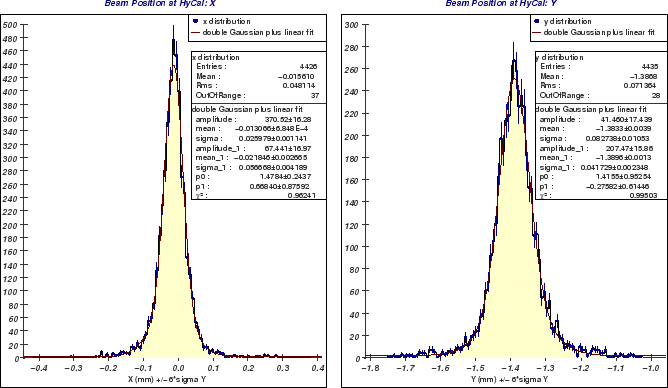
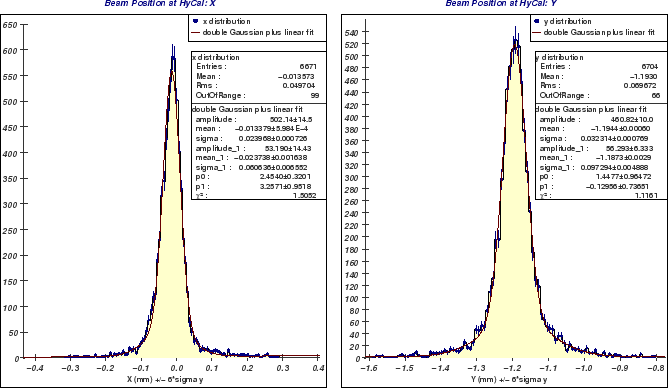
Figures 7 and 8 show the distributions of beam position in transverse directions at HyCal detector.
While coordinate seems to be well centered,  mm with the width of
  mm, for both sets,
coordinate is off-centered by
mm, for both sets,
coordinate is off-centered by  mm, with the width of
  mm, for the first set and
  mm,
with the width of
mm,
with the width of  mm, for the other. It is worth mentioning that beam position as reported by 2C24A monitor has
not changed between the both sets.
mm, for the other. It is worth mentioning that beam position as reported by 2C24A monitor has
not changed between the both sets.
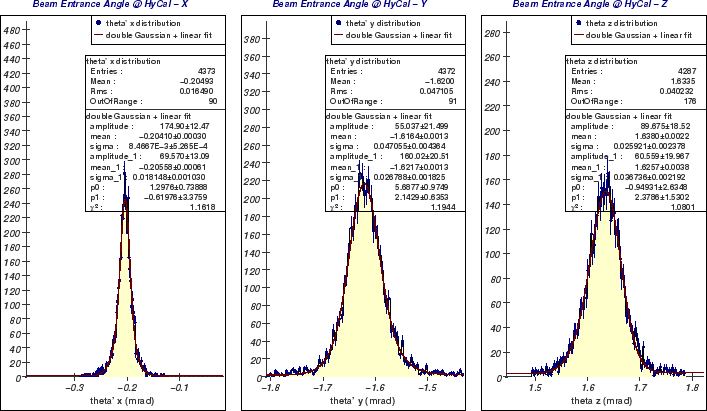
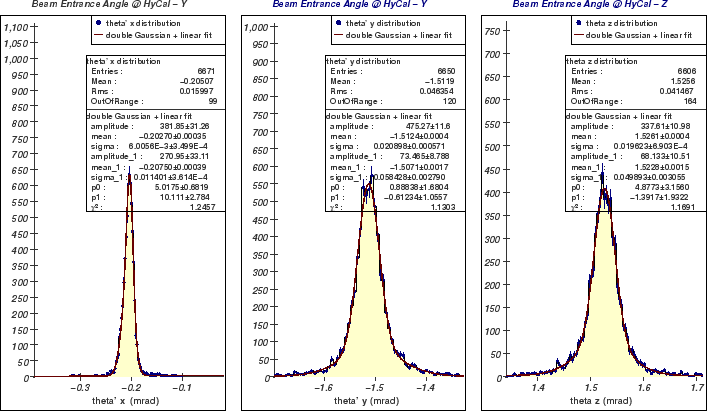
Similarly, the distributions of directional cosines were divided into two sets and Figures 9 and 10 demonstrate
the results. Again, in the direction two distinct average values are observed. In the course of the analysis directional cosines
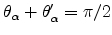
of the beam trajectory relative to HyCal were determined. In Figure 9 the right panel shows the distribution of  ,
an angle between the beam and -direction. The other two angles are primed to distinguish their different definition. These are
the angles that beam makes with its projection on the perpendicular plane.
For both
,
an angle between the beam and -direction. The other two angles are primed to distinguish their different definition. These are
the angles that beam makes with its projection on the perpendicular plane.
For both
 and
and
 the angles are close to 90
 therefore one can write
 where
where  or and
 .
.
The widths of the
 and distributions for runs prior to run 5024 are comparable with the angular resolutions
of the experiment while the angular distributions widths after run 5024, inclusively, tend to be within experimental resolutions.
and distributions for runs prior to run 5024 are comparable with the angular resolutions
of the experiment while the angular distributions widths after run 5024, inclusively, tend to be within experimental resolutions.
 runs used in the study. First 4 rows are high quality data, while the quality of two bottom ones
is a little worse.
runs used in the study. First 4 rows are high quality data, while the quality of two bottom ones
is a little worse.