|
|
TITLE: |
||
|
|
|||
|
DOCUMENT ID: |
6150
Appendix T1 Gas Cylinder
Storage |
||
|
|
|||

1.0
Purpose
The contents of gas cylinders, tanks, and dewars (cylinders) are divided into hazard classes according to their characteristics and likely reaction to other materials. Correct identification of a gas’ hazard class is essential to providing appropriate storage safeguards. This appendix provides the hazard categories and minimum safety requirements for storage of gas cylinders used at Jefferson Lab.
2.0
Scope
It is
recognized that listing the requirements for every gas used at Jefferson Lab
would be prohibitive, it is therefore required that the
gas be identified and stored in accordance with the requirements listed on its safety data sheet (SDS). This appendix defines Jefferson Lab’s requirements in
additional to those listed on the SDS.
Jefferson Lab complies with hazard classes recognized by the industry standards outlined in ES&H Manual Chapter 2410 Appendix T1 Hazard Issues List. This document is produced in coordination with ES&H Manual Chapter 6150 Gas Cylinder Safety – Storage, Movement, and Labeling.
3.0
Responsibilities
NOTE: Management authority may be delegated to a task qualified Jefferson Lab employee at the discretion of the responsible manager.
3.1
Anyone
at Jefferson Lab
· Identify and abide by gas’ hazard class and safety requirements. Contact Industrial Hygiene to perform a hazard evaluation if gas dewars, signs/labels, or other issues do not meet with requirements of associated SDS or this appendix.
3.2 Supervisor/Subcontracting Officer’s Technical Representative (SOTR)/Sponsor
· Ensure cylinder storage area is secure and adequate for gas hazard category(s).
· Perform hazard evaluations and approve areas for specific gas use and storage, as requested.
· Provide safety labels and signs, as required/requested.
4.0
Identify Gas’ Hazard Classes and Safety Requirements
Gas cylinders are to be secured at all times.
Cylinders not in use are to be capped.
A gas’ SDS lists its hazard class and associated safety requirements (see ES&H Manual Chapter 6610 Appendix T1 Safety Data Sheets). All gases are classified by their primary hazards, but may have one or more secondary hazards. Jefferson Lab implements administrative and engineering control measures to protect workers from all associated hazards. Hazard classes of gases used at Jefferson Lab include:
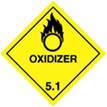
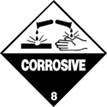
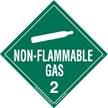
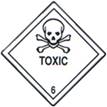
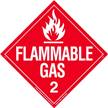
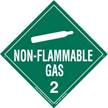
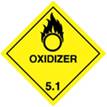
(These are example of typical signage/labels developed by the US Department of Transportation Pipeline and Hazardous Materials Safety Administration. Variations are acceptable.)
4.1
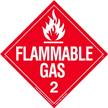 Flammables
Gas that, at ambient temperature and pressure,
forms a flammable mixture with air at a concentration of thirteen (13) percent
by volume or less; or a gas that, at ambient temperature and pressure, forms a
range of flammable mixtures with air wider than twelve (12) percent by volume,
regardless of the lower limit;
4.1.1 Primary Hazard
· Fire/explosion
4.1.2 Secondary Hazard
· Oxygen displacement (see ES&H Manual Chapter 6540 Oxygen Deficiency Hazard Control Program)
· Toxic
· Highly reactive
· Sudden release of pressure
4.1.3 Safety Requirements
· Signage, posted in areas where gas is used and stored (e.g., “Danger – Flammable Gas,” “No Ignition Sources,” “No Smoking or Open Flames”). (Request appropriate (new or replacement signs) from Industrial Hygiene).
· A posted list of responsible persons and their contact numbers.
· Cylinders are stored a minimum of 20-feet away from any source of oxygen (or other oxidizer); or separated by a 5-foot, half-hour, fire-rated wall.
· Fire extinguishers available in storage and work areas.
· Any source of spark or flame is controlled by a work control document (i.e. Hot Work Permit).
· Cylinders, lines, and equipment are bonded and grounded.
· Ventilation of one or more air changes per hour. (This is not applicable to outdoor Jefferson Lab storage.)
4.2
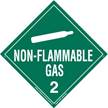 Non-Flammable
Non-flammable gas is gas that
does not burn. It is used during
chemical synthesis, chemical analysis, or preservation of reactive materials.
4.2.1 Primary Hazard
· Oxygen displacement (except oxygen) (see ES&H Manual Chapter 6540 Oxygen Deficiency Hazard Control Program)
4.2.2 Secondary Hazard
· Sudden release of pressure
4.2.3 Safety Requirements
· At a minimum it requires an ODH Safety Review (see ES&H Manual Chapter 6540 Oxygen Deficiency Hazard Control Program)
· Signage, posted in areas where gas is used and stored (e.g., “Danger – Non-Flammable Gas”). (Request appropriate (new or replacement signs) from Industrial Hygiene).
· Continuous ventilation of the area during use.
4.3
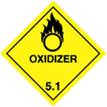 Oxidizer
Oxidizer is a gas that initiates or promotes combustion in other
materials; thereby causing fire either of itself or through the release of
oxygen or other gases.
4.3.1
Primary
Hazard
· Supports combustion.
4.3.2 Secondary Hazard
· Oxygen displacement (except oxygen) (see ES&H Manual Chapter 6540 Oxygen Deficiency Hazard Control Program)
· Fire/explosion
· Toxic
· Highly reactive
· Sudden release of pressure
4.3.3 Safety Requirements
· Signage in areas where gas is used and stored (e.g., “No Smoking or Open Flames”). (Request appropriate (new or replacement signs) from Industrial Hygiene).
· Cylinders are stored 20 feet away from flammables; or separated by a 5-foot, half-hour, fire-rated wall.
· Oil, grease, or other easily combustible materials are prohibited in or around cylinders.
· Any source of spark or flame is controlled by a work control document.
4.4
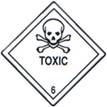
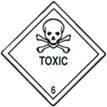 Toxic/Poison
Toxic or poisonous gas causes damage to living tissue, endangers life, or brings about death. Those that do so at low concentrations are “highly toxic.”
4.4.1 Primary Hazard
· Lethal or harmful to humans.
4.4.2 Secondary Hazard
· Fire/explosion
· Highly reactive
· Sudden release of pressure
4.4.3 Safety Requirements
· Strict adherence to the SDS safety requirements for Threshold Limit Values (TLV) and ventilation requirements.
· Minimize exposure - don specialized personal protective equipment (PPE).
4.5
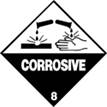 Corrosive
Corrosive is a gas that causes visible destruction of, or irreversible alterations in, living tissue by chemical action at the site of contact.
4.5.1 Primary Hazard
· Damage to living tissue or material.
4.5.2 Secondary Hazard
· Fire/explosion
· Oxidation
· Toxic
· Highly reactive
· Sudden release of pressure
4.5.3 Safety Requirements
· Strict adherence to the SDS safety requirements for TLVs and ventilation requirements.
· Minimum exposure - don specialized PPE.
· Inspect cylinder and valve for corrosion prior to use.
· If the valve or delivery system does not release the gas contact the supplier.
4.6
 Cryogenics
(see ES&H Manual
Chapter 6540 Oxygen Deficiency Hazard Control Program for further details.)
Cryogenics
(see ES&H Manual
Chapter 6540 Oxygen Deficiency Hazard Control Program for further details.)
Cryogenic liquids/gases are extremely cold and can rapidly freeze tissue and other materials.
4.6.1 Primary Hazard
· Damage to tissue or material.
· Oxygen displacement (except oxygen) (see ES&H Manual Chapter 6540 Oxygen Deficiency Hazard Control Program)
4.6.2 Secondary Hazard
· Fire/explosion
· Toxic
· Oxidation
· Sudden release of pressure
4.6.3 Safety Requirements
· Strict adherence to the SDS safety requirements for TLVs and ventilation requirements.
· Minimum exposure - don specialized personal protective equipment (PPE).
The gases most
commonly used at Jefferson Lab and
their primary hazards classes are listed in the table below.
|
Gas |
Primary Hazard Class |
|
Acetylene Deuterium Dimethyl Ether Ethane Isobutane Hydrogen Methane Propane |
Flammables |
|
Argon Carbon Dioxide Helium Nitrogen Refrigerant (R-12, R-22, and other
halogenated hydrocarbons) Sulfur Hexaflouride |
Non-Flammables |
|
Oxygen Air Chlorine Fluorine Nitric Oxide Nitrogen Dioxide |
Oxidizer |
|
Chlorine |
Toxic/Poison |
6.0
References
7.0
Revision Summary
Revision 2.3 – 08/27/2020 – Updated TPOC from T.Menefee to T.Minga
per email from Tim, updated header and footer, No changes to approval and
review dates
Revision 2.2 – 02/13/18 – Updated TPOC from T.Minga to T.Menefee
Revision 2.1 – 06/16/16 – Replaced Material Safety Data Sheet (SDS) with
Safety Data Sheet (SDS)
Revision 2.0 – 08/03/15 – Periodic Review; Appendix T1formerly titled ‘Gas Hazard Classes and Safety Requirements’; Clarified that the contents of gas cylinders are considered chemicals or hazardous material thus covered under a variety of other ES&H Manual Chapters.
Revision 1.0 – 06/15/11 – Updated to reflect current laboratory operations


|
|
ISSUING
AUTHORITY |
TECHNICAL POINT-OF-CONTACT |
APPROVAL
DATE |
REVIEW DATE |
REV. |
|
|
|
ES&H Division |
02/13/18 |
02/13/23 |
2.3 |
|