|
|
TITLE: |
||
|
|
|||
|
DOCUMENT ID: |
6150
Appendix T2 Moving Gas
Cylinders from Building
Storage to Work Area |
||
|
|
|||

1.0
Purpose
Jefferson Lab recognizes the inherent risk of moving gas cylinders, tanks, and dewars (cylinders) from a building storage area to a location within that building. This appendix provides Jefferson Lab’s minimum requirements for performing this operation.
2.0
Scope
It is recognized that listing the requirements for every gas used at Jefferson Lab would be prohibitive, it is therefore required that the gas be identified and stored in accordance with the requirements listed on its safety data sheet (SDS). This document defines actions required by Jefferson Lab in coordination with or addition to those listed on the SDS.
This procedure provides for the movement of gas
cylinders from a building’s storage area to a work area in the same building.
For transport of gas from one building to another, on-site, see ES&H
Manual Chapter 6660 Appendix T1 Transport of Hazardous Material. Off-site shipping requirements are provided in ES&H
Manual Chapter 6660 Appendix T1 Transport of Hazardous Material.
The process steps for these procedures are performed in coordination with ES&H Manual Chapter 6150 Gas Cylinder Safety – Storage, Movement, and Labeling.
3.0
Responsibilities
NOTE: Management authority may be
delegated to a task qualified Jefferson Lab employee at the discretion of the
responsible manager.
3.1 Anyone at Jefferson Lab
· Move gas cylinders in accordance with this procedure.
· Contact Industrial Hygiene for a hazard evaluation if a new gas, or significantly changed procedure is to be used.
|
NOTE: Do not use or move any cylinder that is damaged, leaking, or has illegible or otherwise unintelligible labels. (Notify the Fire Protection Engineer immediately.) |
4.1 Pre-Movement Inspection Activities
Step 1 Verify that the SDS is available and appropriate.
Step 2 Don appropriate personal protective equipment (PPE) as required.
Step 3 Inspect the cylinder for damage and accuracy of labeling.
Follow the steps below when moving cylinders from storage areas to the work area and back. Do not use stairways. See Section 4.4 Cylinders on Elevators if route includes moving cylinder on an elevator.
Step 1 Walk the route. Make sure path is clear. Do not use stairways.
Step 2 Obtain a gas cylinder hand truck (with securing strap or chain) appropriate for the cylinder to be moved.
|
Example
of Gas Cylinder Truck |
|
|
|
NOTE: Use proper equipment for moving
cylinders. Rolling, dragging, or
lifting cylinders is prohibited. |
||
|
|
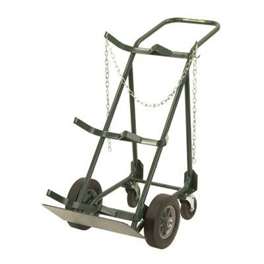
Step 3 Place the cylinder(s) on the gas cylinder hand truck and secure with the strap or chain.
Step 4 Move the cylinder to the work or storage area.
Step 1 Upon arrival at the work/storage location. Remove the cylinder from the gas cylinder hand truck.
Step 2 Secure the cylinder to the wall or storage location with strap, chain, or guard, to prevent falling or tipping.
Step 3 Return gas cylinder hand truck to appropriate location in accordance with department procedures.
4.4.1 Additional Materials and Required Assistance
·
If
required, obtain the elevator “independent service” key from the Fire
Protection Engineer.
·
Print a
“Caution Sign” (click button below for printable version)

·
Bring
Tape.
·
Ask a
second person to assist. Review “Step 4 Retrieval”
duties with the person to ensure they are willing and able to perform the
activities.
Step 1 Move the Cylinder to the elevator per Section 4.2 Moving Cylinder
Step 2 Arrive at Elevator
· Attach the caution sign to the handle of the hand truck with the tape.
Step 3 Position Hand Truck in Elevator
· Send the assistant to meet the elevator at the destination floor.
· Press the elevator call button.
· Upon arrival use the elevator “independent service” key to STOP the elevator (maintain positive control).
· Wheel the hand truck onto the elevator.
· Position the caution sign so it is immediately noticeable to those who may want to enter (i.e., between the hand truck and elevator doors).
· Release the elevator by positioning the elevator “independent service” key to the “OFF” position.
· Leave the key in the lock!
· Press the destination floor button.
· Exit the elevator.
|
NOTE: Never ride in an elevator with a gas cylinder. |
Step 4 Retrieval – (This step is completed by the second person.)
· Wait for the elevator at the destination floor.
· Upon arrival enter the elevator.
· Position the elevator “independent service” key to STOP the elevator (maintain positive control).
· Remove the hand truck and the cylinder from the elevator.
· Position the hand truck and cylinder out of the line of traffic.
· Re-enter elevator and position the elevator “independent service” key to the “OFF” position.
· Remove the key.
· Exit the elevator.
· Wait for the Qualified Gas Worker for further instructions.
|
Do not leave the hand truck or gas cylinder
unattended. |
Step 5
Clean-up
· Continue moving the cylinder to the work or storage area per Section 4.2 Moving Cylinder.
· Return the elevator “independent service” key to the Fire Protection Engineer.
5.0
Revision Summary
Revision 1.5 – 08/27/20 – Updated TPOC from T.Menefee to T.Minga
per email from Tim, updated header and footer, No changes to approval and
review dates
Revision 1.4 – 02/13/18 – Updated TPOC from T.Minga to T.Menefee
Revision 1.3 – 06/16/16 – Replaced Material Safety Data Sheet (SDS) with Safety Data Sheet (SDS)
Revision 1.2 – 08/03/15 – Periodic Review; clarified that the contents of gas cylinders are considered chemicals or hazardous material thus covered under a variety of other ES&H Manual Chapters.
Revision 1.1 – 06/27/11 – Clarified that this document pertains to moving gas cylinders within a single building area.
Revision 1.0 – 06/14/11 – Updated to reflect current laboratory operations.


|
|
ISSUING
AUTHORITY |
TECHNICAL
POINT-OF-CONTACT |
APPROVAL
DATE |
REVIEW DATE |
REV. |
|
|
|
ES&H Division |
02/13/18 |
02/13/23 |
1.5 |
|