|
|
TITLE |
||
|
|
|||
|
DOCUMENT ID |
6160
Appendix T2: Identification
and Classification of Permit-Required
Confined Spaces |
||
|
|
|||

|
At Jefferson Lab a Confined Space Entry (CSE) Permit is considered to be a Work Control Document and thus a Standard Protecting Measure. Only when all hazard issues associated with the PRCS and the work activity are acknowledged and mitigated, in accordance with this program, can the area’s associated Risk Code be considered <2. At a minimum, all work requiring entry into a PRCS is discussed with the entry supervisor prior to commencement of work. A formal Task Hazard Analysis and Operational Safety Procedure is required for work considered to be Risk Code >2 in accordance with ES&H Manual Chapter 3210 Work Planning, Control, and Authorization Process. |
1.0
Purpose
Jefferson Lab’s Facility Design and Modification Review process, outlined within ES&H Manual Chapter 3110 Facility Design and Modification Review, provides initial identification of Permit-Required Confined Spaces (PRCS). This appendix describes how to: identify a PRCS; and, request a classification or re-classification of an area
2.0
Scope
This appendix applies to confined spaces defined in Chapter 6160 Appendix T1 Listing of Permit-Required Confined Space Locations. For information on all posting and entry requirements contact Industrial Hygiene.
The process steps for this procedure are performed in coordination with ES&H Manual Chapter 6160 Confined Space Program.
3.0
Responsibilities
Note: Management authority may be delegated to a
task-qualified TJNAF employee at the discretion of the responsible manager.
3.1
Anyone
at Jefferson Lab
Request a hazard evaluation to classify an identified or suspect area meeting the criteria of a PRCS.
3.2
Supervisors, Technical Representatives (TR), and Sponsors
Ensure appropriate identification of PRCS under your authority.
3.3
Confined
Space Coordinator
Perform an appropriate classification and posting of PRCS, as required per evaluation.
4.0 Procedure
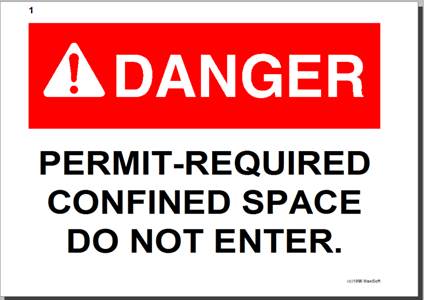
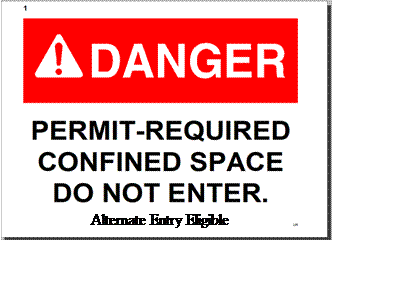
One of the following signs (or similar) are posted at the entrances to identified PRCS’.
|
|
|
|
Figure 1: PRCS |
Figure 2: PRCS, Eligible for Alternate
Entry Certificate |
Anyone at Jefferson Lab may contact Industrial Hygiene and request a hazard evaluation to classify any confined space or reclassify PRCS. In order to be considered a Non-Permit Confined Space, hazards must be eliminated without entry.
Step 1 Perform a Permit Required Confined Space classification evaluation to determine the area’s appropriate classification.
Step 2 Reclassify the area as appropriate:
· Post appropriate signage.
· Inform the following of the determination:
1. Facilities and Logistics Management
2. The space owner
3. Any concerned party(s)
5.0
Revision History
|
summary |
date |
|
|
2.1 |
periodic 3-year review, no changes per TPOC ES&H Manual Editor: updated 3.0 Note;
general format updates; change to table format of Revision History; updated
header and footers; changed ESH&Q to ES&H and SOTR to TR throughout |
03.04.2023 |
|
|
periodic review;
no changes per TPOC |
10.14.2019 |
|
2.0 |
periodic review; formerly titled
‘Confined Space Entry Training Requirements’; added process steps for
reclassification of a PRCS area; updated TPOC from ROwen
to JWilliams |
10.14.2016 |
|
1.1 |
update TPOC from JKelly
to ROwen |
07.23.2014 |
|
1.0 |
periodic review;
update to reflect current laboratory operations |
06.20.2012 |
|
0.0 |
updated to web version |
08.30.2006 |




|
|
ISSUING
AUTHORITY |
TECHNICAL
POINT-OF-CONTACT |
APPROVAL
DATE |
REVIEW DATE |
REVIEW
CYCLE |
rev |
|
|
|
ES&H Division |
10.14.2016 |
03.04.2023 |
3 years |
2.1 |
|