TITLE:

ES&H Manual


DOCUMENT ID:

5300 Occurrence Reporting


1.0          Introduction


Jefferson Lab’s ESH&Q program is designed to prevent unplanned events.  However, if such an event—termed an occurrence—takes place, Jefferson Lab will investigate and analyze the mishap to discover the cause and prevent similar incidents from recurring.  In order to help other research facilities avoid potential safety problems, Jefferson Lab shares its occurrence reports with the Department of Energy (DOE).  The information is put into a computerized occurrence reporting and tracking system shared by all DOE facilities, allowing them to better prevent, control, and respond to similar situations.


Because of the desire to keep the Department of Energy informed about current Jefferson Lab safety issues, this facility sends DOE an occurrence report on any event that has or could:


·       endanger workers

·       affect the public's safety and health

·       seriously impact the laboratory

·       adversely affect the environment


The Jefferson Lab Occurrence Reporting Program for reportable occurrences is based on the requirements contained in DOE Order 231.1A, Environment, Safety, and Health Reporting, and DOE Manual 231.1-2, Occurrence Reporting and Processing of Operations Information (ORPS). This guidance became effective at Jefferson Lab on December 1, 2003 and all new occurrences are being reported using the new reporting criteria.


The new DOE ORPS guidance establishes a graded approach for reporting and investigation of occurrences. This approach identifies the required reporting timelines, level of investigation and causal analysis, approval, corrective action development, verification, and validation for the various severity categories.


The DOE Order establishes the following severity categories in addition to Emergency Events such as Operational Emergencies (OEs) (as defined in applicable DOE emergency management guidance found in DOE 151.1A). OEs, as defined in this DOE Order, are not likely to occur at Jefferson Lab or the other two program dedicated research accelerator facilities (the Fermi National Accelerator Laboratory and the Stanford Linear Accelerator Center) unless from off-site hazardous material releases.


Significance Category 1: Occurrences that have a significant impact on safe facility operations, worker or public safety and health, regulatory compliance, or public/business interests.


Significance Category 2: Occurrences that have a moderate impact on safe facility operations, worker or public safety and health, regulatory compliance, or public/business interests.


Significance Category 3: Occurrences that have a minor impact on safe facility operations, worker or public safety and health, regulatory compliance, or public/business interests.


Significance Category 4: Occurrences that have some impact on safe facility operations, worker or public safety and health, regulatory compliance, or public/business interests.


Significance Category R: Occurrences identified as recurring, as determined from the periodic performance analysis of occurrences.


The Jefferson Lab Facility Manager Designee must notify the DOE Site Office Facility Representative and the DOE Headquarters Operations Center (DOE HQ OC) as required, of the following reportable occurrences as soon as practical, but no later than 2 hours after categorization:


1.     All Significance Category 1, 2, and R occurrences require a prompt notification to the Facility Representative and DOE HQ OC.


2.     All Significance Category 3 and 4 occurrences require a prompt notification to the Facility Representative.


3.     Additionally, specific Significance Category 3 and 4 occurrences (identified as requiring prompt notification with an asterisk (*) in the reporting criteria listed in ES&H Manual Chapter 5300 Appendix T1 Occurrence Reporting and Notification Procedures) require prompt notification to the DOE HQ OC


Jefferson Lab events that may influence performance, reliability, safety or the environment, but do not fully meet DOE occurrence reporting criteria, are classified as Notable Events.  ES&H Manual Chapter 5300 Appendix T3 Notable Event and Notification Procedure, describes how other staff are made aware of notable events so they may take steps to prevent similar events


Important personnel and organization phone numbers are provided in Table 1 of ES&H Manual Chapter 5300 Appendix T1 Occurrence Reporting and Notification Procedures for use in making any type of notification.


Specifics on time guidelines for initial notification and categorizing an occurrence are in ES&H Manual Chapter 5300 Appendix T1 Occurrence Reporting and Notification Procedures. The guidelines in ES&H Manual Chapter 5300 Appendix T2 Occurrence Documentation and Tracking Procedure are to be followed for occurrence report preparation and follow-up activities.


Jefferson Lab’s occurrence reporting system improves communications and facilitates a meaningful exchange of lessons learned through fact finding, rather than fault finding, at Jefferson Lab and other facilities in the DOE complex.


Occurrence Reporting Orientation Briefings

Orientation briefings on occurrence reporting requirements will be conducted by ESH&Q Reporting staff for management personnel in each Jefferson Lab Division and Office. All Jefferson Lab staff will be informed of the occurrence reporting program by the distribution of appropriate information. Ongoing occurrence reporting awareness information will be incorporated into annual emergency management information that is provided to Jefferson Lab staff.


The briefings for management staff include the following areas:

·       occurrence reporting philosophy

·       identification, classification, and notification requirements of occurrence reporting

·       analysis and closure process

·       use of the ORPS database for appropriate “lessons learned”


2.0          Key Terms


Jefferson Lab Facility Manager  The person with direct line responsibility for operation of Jefferson Lab, including authority to direct physical changes to a facility. The Facility Manager and his alternates are listed in Table 1, ES&H Manual Chapter 5300 Appendix T1 Occurrence Reporting and Notification Procedures


notable event An unplanned or abnormal incident that affects or has the potential to affect performance, reliability, safety, or the environment but does not fully meet DOE occurrence reporting criteria.


reportable occurrence  Any unusual or unplanned event that has or could adversely affect public health, the performance, reliability, or safety of a facility, or the environment, as described in ES&H Manual Chapter 5300 Appendix T1 Occurrence Reporting and Notification Procedures. Reportable occurrences are classified by their potential for personal injury, environmental damage, and/or equipment loss. Additional information on the occurrence categorization process is available in DOE Manual 231.1-2.


DOE Occurrence Reporting and Processing System of Operations Information (ORPS) An electronic, internet-based reporting and incident tracking system. The system lets staff at DOE sites and facilities across the country share occurrence/incident information and lessons learned.


Text Box: NOTE:  For the purpose of this chapter and its appendices, use of the term Facility Manager, DOE Facility Representative, program manager, Associate Director, supervisor, crew chief, etc., also includes all alternated.  The term “supervisor” also applies to Subcontracting Officer’s Technical Representatives (SOTRs) and Jefferson Lab sponsors.

3.0          Responsibilities


Everyone At Jefferson Lab - In The Event of an Unplanned Event

·       Initiate evacuation of the area, if warranted, and if safe to do so, acts to minimize the hazard.

·       Call 911 to request an emergency response team, if needed.

·       Call ext. 4444 to notify Jefferson Lab Security of the nature and location of the problem.

·       For any potentially reportable incident within the accelerator complex fence, notify the Machine Control Center crew chief (ext. 7045, cellular phone # 630-7045).

·       Advise your supervisor of all potentially reportable events, and the time you became aware of them. If you are unsure whether an event meets reporting criteria, report the event to your supervisor as soon as possible.

·       Don’t disturb the accident area, except to prevent further injury or damage.

·       Refer to ES&H Manual Chapter 3510 Emergency Management Plan and ES&H Manual Chapter 5200 Incident/Injury Investigation.

·        

Crew Chiefs or Supervisors

·       Upon discovery, notify the Facility Manager Designee at cellular phone # 876-1750 of a potentially reportable event.

·       Start a written chronology of events.

·       Reportable and potentially reportable events are to be reported through the line management chain to the Jefferson Lab Director as soon as possible anyway.

·       Fill out and submit written notification and follow-up reports within time limits, per ES&H Manual Chapter 5300 Appendix T1 Occurrence Reporting and Notification Procedures and ES&H Manual Chapter 5300 Appendix T2 Occurrence Documentation and Tracking Procedure.  Assess applicability of ES&H Manual guidance and work control documents and make recommendations for improvements to the guidance that could help to avoid a repeat of the occurrence.

·       Implement all necessary corrective actions identified on reports.


Facility Manager Designee

·       Decide if an event is reportable, and if so, categorize it with Facility Manager concurrence. See ES&H Manual Chapter 5300 Appendix T1 Occurrence Reporting and Notification Procedures for guidelines in categorizing an occurrence.

·       Oversee the notification of DOE personnel as specified in ES&H Manual Chapter 5300 Appendix T2 Occurrence Documentation and Tracking Procedure.

·       Oversee input of report information into the DOE operational database


ESH&Q Reporting Manager

·       Facilitate the occurrence reporting, documentation, and tracking procedures.

·       Maintain a log of site incidents that were reported internally but were determined not to be reportable to the DOE or the National Response Center.

·       Review the ORPS database at least quarterly for incidents of potential interest to Jefferson Lab.

·       Distribute information from such reports to staff through appropriate means, such as telephone, electronic mail, ESH&Q messages, meeting minutes, and newsletters.

·       Refer ESH&Q Manual change recommendations resulting from incident investigations to the ESH&Q Policies and Manuals Manager.


ESH&Q Staff

·       Conduct “lessons learned” briefing or distribute appropriate information for supervisors in each division, if applicable to the activities of that division.


4.0          Program Summary


Jefferson Lab’s Occurrence Reporting Procedure, that identifies the site process for reporting an event or situation, strives to improve communication and facilitate a meaningful exchange of lessons learned through fact finding, not fault finding, here and at other facilities in the DOE complex.


Reportable events include, but are not limited to:


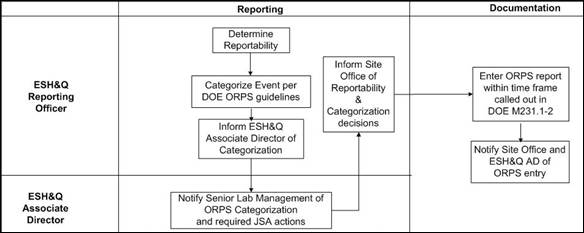
ES&H Manual Chapter 5300 Appendix T1 Occurrence Reporting and Notification Procedures covers occurrence categorization and outlines initial notification procedures.  ES&H Manual Chapter 5300 Appendix T2 Occurrence Documentation and Tracking Procedure. explains follow-up reporting requirements. Notification and reporting procedures are broken down into specific tasks.


Initial Discovery and Response

Anyone witnessing an accident or potentially dangerous situation should initiate basic hazard response activities, such as evacuating a building or contacting the appropriate disaster response team, fire department, or ambulance, via phone number 911 and Security, ext. 4444. For incidents within the accelerator complex fence, the crew chief (ext. 7045, cellular phone # 630-7045) must be notified immediately.

If you discover a potentially reportable event, advise your supervisor as soon as possible.


Notifications

The Facility Manager/Designee checks the information for errors and categorizes the occurrence. If the event is determined to be reportable, the Facility Manager makes the necessary DOE notifications.


Documentation, Follow-up and Corrective Action

Supervisors having responsibility for the problem area provide documentation of events and circumstances, and implement necessary corrective action.  Documentation should include an assessment of applicable ESH&Q Manual guidance or work control document provisions which address the circumstances and why they were not effective in preventing the problem. Recommendations to correct identified shortcomings should be provided to reduce the likelihood of a repeat occurrence.


Applicable Line Management and the Facility Manager approve report information for entry into the DOE ORPS database. The report shall provide references to documentation of apparent cause analysis or other causal analysis if applicable.


Support

The ESH&Q Reporting Manager oversees the occurrence reporting system, maintains awareness of reporting requirements, informs other personnel with reporting responsibilities, and disseminates information of interest to Jefferson Lab staff.