|
|
TITLE: |
||
|
|
|||
|
DOCUMENT ID: |
6610
Appendix T3 Chemical Labeling, Storing, and Transporting Requirements |
||
|
|
|||

|
Jefferson Lab has determined that working with chemicals carries an unmitigated Risk Code >2. At a minimum all tasks requiring chemicals are discussed with the supervisor prior to commencement of work. An Operational Safety Procedure (OSP) is written for work considered to be Risk Code >2 in accordance with ES&H Manual Chapter 3210 Work Planning, Control, and Authorization Process. |
Jefferson Lab recognizes that chemicals can
be hazardous. Minimum labeling, storage, and transportation requirements have
been established for use when working with any that fall into that category. These
requirements are over and above those listed on a chemical’s safety data sheet (SDS).
It is recognized that listing the
requirements for every chemical used at Jefferson Lab would be prohibitive; it
is therefore required that qualified chemical workers read and follow the requirements/recommendation listed on a chemical’s SDS.
This procedure defines actions Jefferson Lab requires in addition to those
listed on the SDS.
This appendix’s process steps are performed in coordination with ES&H Manual Chapter 6610 Chemical Hygiene Program.
NOTE: Management authority may be delegated at the discretion of the responsible manager.
·
Follow the requirements/recommendations listed on the SDS.
· Ensure all chemicals are labeled, stored, and
transported in accordance to the requirements of this appendix. Contact the SDS
Coordinator for more information.
· Perform area
hazard evaluations and provide signage as appropriate.
· Inform Jefferson Lab Stockroom of the
appropriate chemical content labels that are to be made available.
· Maintain supply of chemical content labels and National Fire Protection Association (NFPA) 704 hazard diamond stickers.
· Maintain or make available a supply of compatible material containers for transfer of chemicals.
Unless otherwise noted anyone may perform the process steps listed below.
Containers, piping, rooms,
cabinets, refrigerators, etc. used to store or transfer chemicals are
appropriately labeled. Hazard evaluations determine signage and labeling
requirements. Contact the Industrial Hygiene to schedule an
evaluation.
Examples of chemical hazard signage include:
|
Example 1: Flammable Storage Area Danger Sign |
Example 2: Acid Storage Area Danger Sign |
Example 3: Extremely
Hazardous – Highly Toxic Danger Sign |

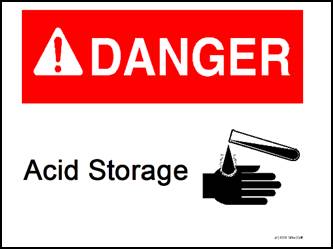
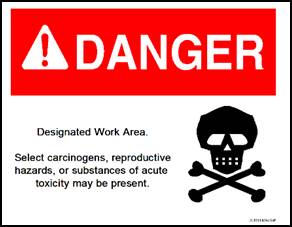
4.1.1 Chemical Containers
All chemical containers are required to be
labeled. Labels provided by chemical manufacturers
must remain on containers. Manufacturer’s labels will container the following
information (see figure 1 for label example):
· Product Identification and
Supplier information
· Precautionary statements
and measures to be taken to minimize or prevent adverse effects
· First aid information
·
Pictograms to alert chemical users to the chemical hazards to
which they are exposed. There are nine pictograms that represent distinct
hazards (see figure 2 for pictogram information)
·
Severity of hazard using signal words: “Danger” or “Warning”
o
Signal word Danger implies a higher hazard than Warning
·
Describe the nature of the hazards
· Describe directions for use
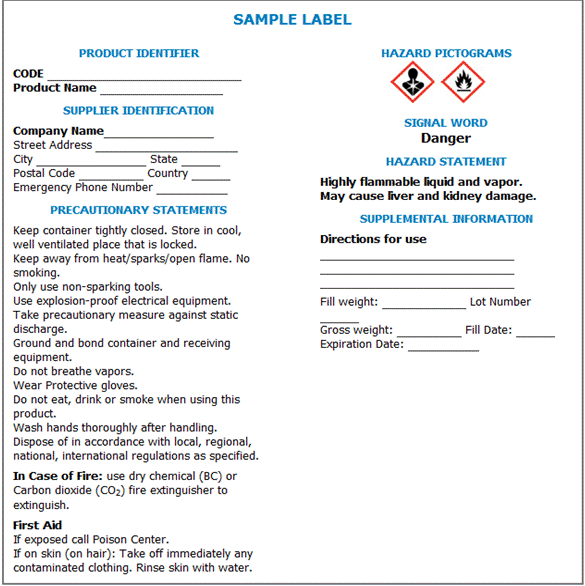
Figure
1: example manufacturer label
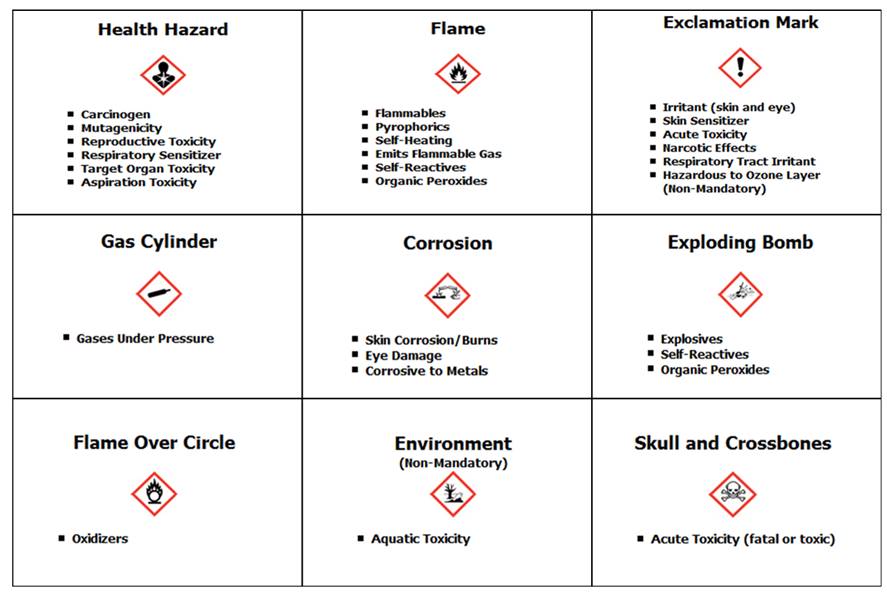
Figure 2: Nine pictograms found on manufacturer containers
and SDSs
•
NFPA 704 Hazard Diamond Labels must
be used when chemicals are poured from a manufacturer bottle into a new
container.
Step
1:
Obtain a NFPA 704 Hazard Diamond Label from
the Jefferson Lab Stockroom. See Webstock for ordering information.
|
Chemical Name: ________________________ |

Step
2:
Review the chemical’s SDS or consult with the
SDS Coordinator to determine hazard ratings.
Step 3: Fill in the label (include chemical name and hazard ratings). See Section 5.0 References Table 2 – Rating Summary.
Step 4: Affix label to chemical container.
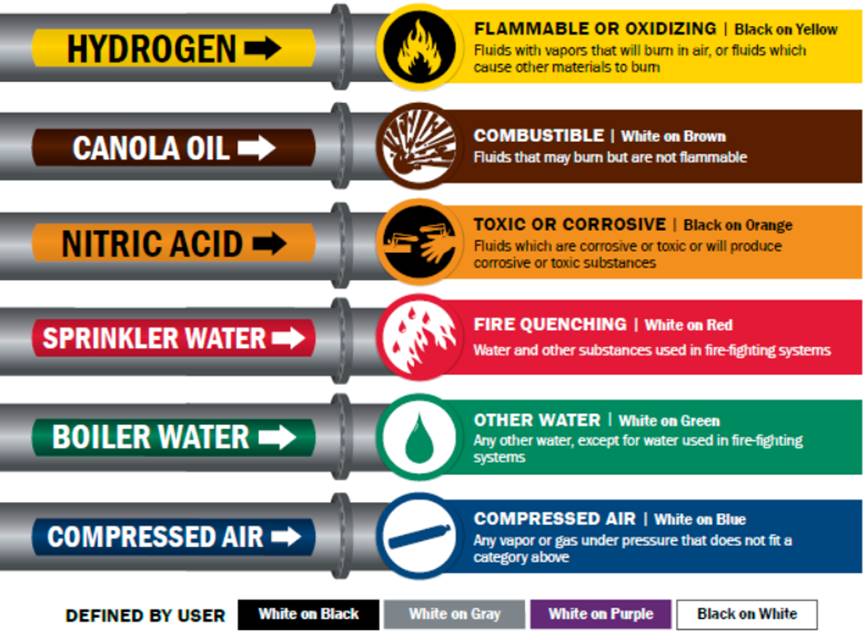
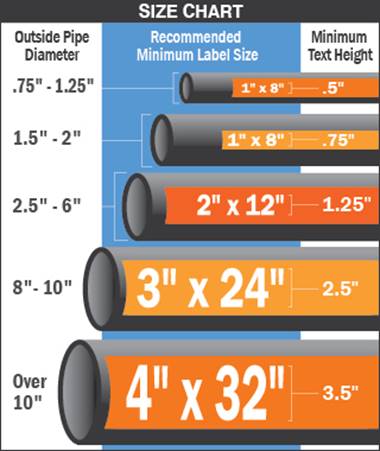
Piping containing gases or liquid must be marked with contents per ANSI/ASME A13.1-2015 using following scheme:
Figure 1 - Designation of Colors
Source: https://www.graphicproducts.com/articles/ansiasme-a131-pipe-labeling-requirements/
Figure 2 - Location of Identification Markers

Source: https://www.graphicproducts.com/articles/ansiasme-a131-pipe-labeling-requirements/
Figure 3 - Size of Legend Letters
Source: https://www.graphicproducts.com/articles/ansiasme-a131-pipe-labeling-requirements/
Contact the Industrial Hygiene for piping label requirements.
The SDS Coordinator keeps a record of all chemical storage areas at
Jefferson Lab and performs annual inspections to ensure proper storage
techniques.
Contact the Industrial
Hygiene for a determination regarding new or unique
storage requirements. The minimum requirements are:
It is preferred that chemicals be stored in
their original container. If transfer is required an approved container and/or compatible
material is used.
·
Obtain containers from Jefferson Lab Stockroom.
·
Visually inspect a container’s integrity
prior to transfer. Do
not use a container if it is dented, punctured, cracked or otherwise
damaged.
· Ensure
appropriate labeling.
·
Store only the minimum amount of chemical required.
·
Keep container closed, and caps and lids securely
tightened, when not
in use.
|
REMEMBER: Use grounding
and bonding techniques to prevent static build-up particularly while
performing transfer operations between containers. Contact the Industrial
Hygiene if you need assistance with this
operation. |
4.2.2
Designated Storage Areas
When not in use, chemicals are stored in designated
storage areas constructed of compatible material in accordance with:
·
SDS
requirements/recommendations
·
The Compatibility Table (located on flammable storage
cabinets)
·
Direction from the Industrial
Hygiene
A designated area is
required for these chemicals. The area may consist
of a glove box, a portion of the laboratory, or the entire laboratory.
·
Access is restricted by
lock and key (or equivalent) and posted with “Authorized Personnel Only”
warning.
·
Only Qualified
Chemical Workers, trained in the hazards and safe handling requirements of the carcinogens/poisonous chemical,
may access the designated area.
When required/recommended by the SDS, chemicals are
stored in designated storage cabinets constructed of appropriate material. Do
not open a cabinet if there is evidence of damage, leakage, or open containers. Contact
the Industrial
Hygiene (x7882) for
assistance.
4.2.3.1 Purchase: Follow the process steps below to
obtain an appropriate cabinet.
Step
1:
Contact the Industrial Hygiene regarding
purchase recommendations/requirements.
Step
2:
Order the cabinet
through Jefferson
Lab Stockroom.
Step
3:
Set-up
–
Flammable Storage Cabinet – must be
grounded prior to use by a qualified technician or facilities management. Use
the Facility Management Service Request System to
request installation.
4.2.3.2
Flammables Storage Cabinets
Flammable chemicals are stored in
flammable storage cabinets in accordance with the SDS
recommendations and away from ignition sources. Flammables
storage cabinets meet National Fire Protection Association (NFPA) 30 – Flammable and
Combustible Liquids Code specifications; and are used according to
manufacturer’s instructions. When cold storage is required, explosion-proof refrigerators clearly
labeled “NO FOOD” are used.
|
NOTE: · Do not store
paper, cardboard, or other combustible material in or on a flammable storage
cabinet. ·
Do not store small cylinders of compressed or
liquefied gases in flammable storage cabinets. |
·
Refer to Table 1: NFPA Flammability Classes (below) to
determine a chemical’s classification.
Table 1: NFPA Flammability Classes
|
Flash Point |
Boiling Point |
Classification |
|
<37.8°C (100°F) |
|
Class I |
|
<22.8°C (73°F) |
<37.8°C (100°F) |
Class IA |
|
<22.8°C (73°F) |
≥37.8°C (100°F) |
Class IB |
|
≥22.8°C (73°F) |
<37.8°C (100°F) |
Class IC |
|
≥37.8°C (100°F) |
<60°C (140°F) |
Class II |
|
≥60°C (140°F) |
<93°C (200°F) |
Class IIIA |
|
≥93°C (200°F) |
|
Class IIIB |
· Abide by the
following quantity limits:
o
Ensure the total amount of Class I, Class II, and
Class IIIA liquids in a cabinet is <120 gallons (454 liters)
o
Ensure that of the 120-gallon total, the combined quantity of Class I and
Class II liquids is <60 gallons (227 liters).
4.3
Transportation
4.3.1
On-Site Transfer
Transferring chemicals from one area to another, within the
continuous boundary of Jefferson Lab, is performed in accordance with the
requirements of ES&H
Manual Chapter 6660 Appendix T1 Transport of Hazardous Material
4.3.2
Off-Site Shipping
Shipping of
chemicals to a location outside the continuous boundary of Jefferson Lab
requires special training. Off-Site Shipping Requirements are provided in ES&H Manual Chapter
6660 Appendix T1 Transport of Hazardous Material.
5.0 References
Table 2 – Rating Summary
|
Color Code |
# Designation |
Description |
|
HEALTH |
4 |
Extremely
Toxic - very short exposure interval. ·
Specialized protective equipment
required. ·
Could cause death or major
residual injury even with prompt medical treatment. ·
A known or suspected human
carcinogen, mutagen or teratogen. |
|
3 |
Seriously
Toxic – Corrosive.
|
|
|
2 |
Moderately toxic material. ·
May be harmful if inhaled or absorbed ·
Intense or continued exposure could cause temporary incapacitation or
possible residual injury unless prompt medical treatment is given. |
|
|
1 |
Slightly toxic material.
·
Recognized innocuous material when used with responsible care |
|
|
0 |
Minimal – No unusual hazard. No chemical is without some degree of toxicity. |
|
|
|
||
|
FLAMMABILITY |
4 |
Extremely
Flammable – gas or liquid Flash
point below 73 F (22.8 C) |
|
3 |
Seriously
Flammable – flash point below 100° F
· Flash point at or above 73 F (22.8 C) but less than
100 F (37.8 C). |
|
|
2 |
Moderately
Combustible – liquid flash point of 100° to 200° F
· Flash point at or above 100 F (37.8 C) but less than
200 F (93.4 C). |
|
|
1 |
Slightly
Combustible if heated
· Flash point at or above 200 F (93.4 C). |
|
|
0 |
Not
combustible
· Will not burn in air when exposed at 1500 F (815.5
C) for 5 minutes. |
|
|
|
||
|
REACTIVITY |
4 |
Extremely
Explosive at room temperature
|
|
3 |
Seriously
Explosive – if shocked, heated under confinement or mixed with water.
|
|
|
2 |
Moderately
Unstable – may react violently if mixed with water.
· Forms potentially explosive mixtures with water. |
|
|
1 |
Slightly
Reactive – May react if heated or mixed with water but not violently · Normally stable material which can become unstable
at high temperature and pressure. |
|
|
0 |
Normally
stable material which is not reactive with water. |
|
|
|
||
|
SPECIAL
NOTICE |
|
Water Reactive/Use no water |
|
OXY |
Oxidizing Agent |
|
|
COR |
Corrosive |
|
|
ACID |
Acid |
|
6.0
Revision Summary
Revision 1.4 – 07/1/2020 – Periodic Review; Updated webstock to stockroom, updated form to show ES&H
division under Rev history, Manual header changed to reflect POC as T. Johnson.
Revision 1.3 – 04/04/17 – Updated to include GHS labeling information re:
CATS # MOA-2017-03-02-01l
Revision 1.2 – 06/14/16 – Periodic Review; replaced Material Safety Data Sheet (MSDS) with Safety Data Sheet
(SDS)
Periodic Review – 06/28/13 – No
substantive changes per J.Williams
Revision 1.1 – 01/25/12 – Updated
Section 4.3 Transportation to reflect requirements of Chapter 6660
Hazardous Material Transport
Revision 1.0 – 07/05/10 – Updated to reflect current laboratory operations



|
|
ISSUING
AUTHORITY |
TECHNICAL POINT-OF-CONTACT |
APPROVAL
DATE |
REVIEW DATE |
REV. |
|
|
|
ES&H Division |
07/01/2020 |
07/01/23 |
1.4 |
|