|
|
TITLE: |
||
|
|
|||
|
DOCUMENT ID: |
6610
Appendix T5 Chemical Personal
Protective Equipment and Associated Control Measures |
||
|
|
|||

|
Jefferson Lab has determined that working with chemicals carries an unmitigated Risk Code >2. At a minimum all tasks requiring chemicals are discussed with the supervisor prior to commencement of work. An Operational Safety Procedure (OSP) is written for work considered to be Risk Code >2 in accordance with ES&H Manual Chapter 3210 Work Planning, Control, and Authorization Process. |
Jefferson Lab requires that
everyone working with chemicals read and follow the
recommendations/requirements for personal
protective equipment (PPE) and control measures
listed on the chemical’s Safety Data Sheet
(SDS). If none are stated, minimum PPE requirements and control measures are
listed within this appendix.
PPE does not take the place of
engineered and administrative control measures; rather it is used in
conjunction with them to increase the safety of everyone at Jefferson Lab.
This appendix applies to
Jefferson Lab’s minimum chemical PPE requirements. Always refer to applicable Work
Control Documents (e.g. OSP and/or Task Hazard Analysis) for guidance on PPE
required for your work. See also: ES&H Manual
Chapter 6620 Personal Protective Equipment Program
for guidance regarding the use of “basic PPE.”
This
appendix’s process steps are used in coordination with ES&H Manual
Chapter 6610 Chemical Hygiene Program.
NOTE: Management authority may be delegated at the discretion of the responsible manager.
3.1
Qualified Chemical Workers
·
Inspect PPE before and after use. Dispose
of damaged items appropriately.
·
Wear appropriate PPE while working with chemicals.
·
Utilize hazard controls in accordance
with manufacturer instructions and/or area work control documents.
·
Submit a Facilities Management Work
Request for repair of damaged or malfunctioning control
measures.
· Contact the Industrial Hygienist regarding appropriate chemical PPE and other control measures.
3.2 Supervisor/Subcontracting Officer’s Technical Representative (SOTR)/Sponsor
· Ensure qualified chemical workers are trained on appropriate PPE requirements.
· Ensure appropriate PPE and control measures are available to chemical workers.
· Retain an up-to-date permeation/degradation guide for hand protection for all gloves types used at Jefferson Lab.
· Retain an up-to-date permeation/degradation guide for body protection used at Jefferson Lab.
· Maintain and provide respirators/SCBAs equipment and training as required.
· Ensure appropriate eye protection, glove selection, and other identified chemical PPE is made available through Jefferson Lab Webstock or in the stockroom.
· Obtain Industrial Hygienist approval prior to stocking new types of chemical PPE.
All of the following is
required when working with chemicals, or within
an area designated as a chemical laboratory.
·
Proper work clothing,
·
Substantial closed
toe/heal shoes (i.e., no sandals), and
·
Tied-back hair.
Table 1: Body
Protection Chart
|
Degree of
Hazard |
Hazard |
Required
Protection |
Examples of
Typical Applications |
|
Low
|
Skin
irritation |
|
· No
shorts · No
skirts · Closed
toe/heal shoes |
· Micro
detergent · Non
carcinogenic, non skin absorbing · Solvent
in squeeze bottle quantities · HD
degreaser |
|
Medium |
Skin
defatting/ sensitization |
|
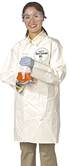
· Lab
coat · No
shorts · No
skirts · Closed
toe/heal shoes |
· Solvent
use in quantities greater than squeeze bottle · Acid
or base < 1 liter
(non-HF containing acids) · First
aid response (severity dependent) |
|
High |
Burns Systemic
effects from skin absorption |
|
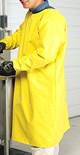
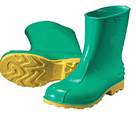
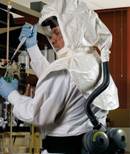
· Yellow neoprene apron · Rubber
boots · Optimair
TL PAPR with Tychem SL hood (SAF 200 training required) |
· Acids
and bases in quantities greater than 1 liter · HF
containing acids in any quantity · First
aid response (severity dependent) |
4.2
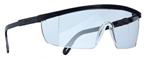
Eye and Face Protection – one of the following as appropriate:
·
Safety Glasses with side shields:
o Flammables
o Diluted detergents
o Squeeze bottles of solvents
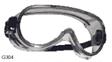
·
Goggles:
o
Corrosives
o
When handling
< 4 liters (~1 gallon) of any liquid chemical
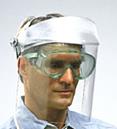
·
Full Face Shield over Goggles:
o When there is a chance of a splash to the face (i.e. pouring
activities), or
o When
handling > 4 liters (~1 gallon) of liquid.
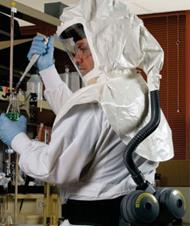
·
Encapsulating Hood (available from the
Industrial Hygienist along with specific training):
o Hydrofluoric acid (HF).
Table 2: Eye and
Face Protection Chart
|
Degree
of Hazard |
Hazard |
Required Protection |
Examples of Typical Applications |
|
|
Low |
Splash |
|
·
Safety glasses with side shields
|
·
Entry into the chemistry area ·
Micro detergent ·
Squeeze bottles of solvents |
|
Medium |
Splash Burns |
|
·
Goggles ·
Full Face shield over goggles
required depending on task (refer to THA) |
·
Solvent use in quantities
greater than squeeze bottle ·
Acids and bases of any quantity
(non-HF acids) |
|
High |
Burns Systemic
effects from skin absorption |
|
· Encapsulating Hood (e.g.: OptimAir TL Powered Air Purifying
Respirator (PAPR) with loose-fitting Tychem SL hood) · (SAF
200 training required) |
·
HF containing acids in any
quantity ·
Pair part etching |
4.3
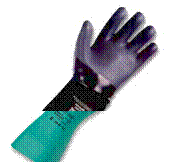
Hand
Protection (gloves)
– Refer to the permeation/degradation guide (available from the glove
manufacturer) or consult with Industrial Hygienist for the appropriate hand
protection for your application.
Table 3:
Hand Protection Chart
|
Degree of Hazard |
Hazard |
Required Protection |
Examples of Typical Applications |
||
|
Low |
Skin
irritation |
|
none |
· Micro
Detergent · Non
carcinogenic, non skin absorbing solvent in squeeze bottle quantities · HD degreaser |
|
|
Medium |
Skin
defatting/ sensitization |
|
· Single glove · Check glove
com-patibility chart |
· Solvent use in
quantities greater than squeeze bottle |
|
|
High |
Burns |
Nitrile |
Neoprene |
· Check glove
compatibility chart. · Discard glove
immediately after use. · Proper glove
selection is task dependent. Refer to THA for
proper glove selection. |
· Acids and
bases in quantities greater than 1 liter · Transporting
closed containers of acids & bases · First aid
response · Acid etching · Solvents · Epoxy Resins · Ensolv |
|
Silvershield |
|||||
|
PVA |
PVC |
||||
|
|
Burns Systemic
effects from skin absorption |
Inner: Nitrile
Outer: Neoprene |
· Double
glove: · Rinse outer-
glove immediately after use or discard. · Discard inner
glove after use. |
· HF containing
acids in any quantity · Moving large
acid carboys ( >2 gallons) (acid not in manufacturer’s 1 gallon
bottle) |
|



5.1
All
basic, non-specialized PPE is available through Webstock or in the stockroom. (See ES&H Manual 6620
Appendix T1 Selecting, Acquiring, Training, and Caring for Personal Protective
Equipment for further information.)
5.2
Specialized
PPE, as listed on the SDS, or as required by the associated Operational Safety
Procedure (OSP), can be ordered through the Jefferson Lab Webstock. Contact the Industrial Hygienist for
additional information or assistance.
6.0
Associated
Control Measures
· See ES&H Manual Chapter 6630 Respiratory Protection Program
·
See ES&H Manual Chapter 8061 Hazardous Waste Management
7.0
Revision Summary
Revision 1.3 – 06/14/16 – Periodic Review; replaced Material Safety Data Sheet (SDS) with Safety Data Sheet
(SDS)
Revision 1.2 – 06/28/13 – Updated examples of in Hand Protection Chart
Revision 1.1 – 06/08/11 – Added tables with
pictures of minimum PPE to clarify requirements
Revision 1.0 – 07/05/10 – Updated to reflect current
laboratory operations


|
|
ISSUING
AUTHORITY |
TECHNICAL
POINT-OF-CONTACT |
APPROVAL
DATE |
REVIEW DATE |
REV. |
|
|
|
ES&H Division |
06/14/16 |
06/14/19 |
1.3 |
|